
The Honeymooners
Mid-1950s American television sitcom starring Jackie Gleason as bus driver Ralph Kramden, centered on working-class married life in New York City. Famous for its comic quartet and enduring cultural influence.
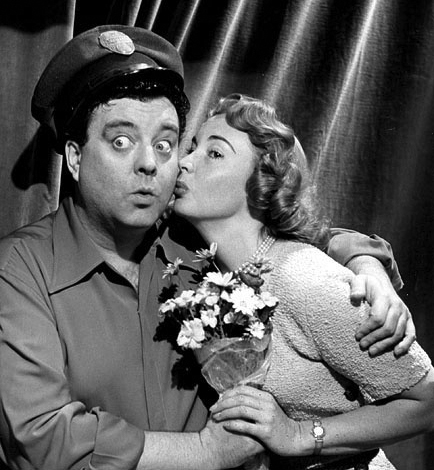
The Honeymooners is a mid‑1950s American sitcom that presented a compressed, comic portrait of working‑class married life. The half‑hour program is best known for Jackie Gleason's performance as Ralph Kramden, a blustery bus driver, alongside Audrey Meadows as his patient wife. The principal ensemble also included Art Carney and Joyce Randolph, and the series reached national audiences on CBS between October 1955 and September 1956. Its most famous run of 39 episodes is frequently referred to as the "Classic 39."
Image gallery
9 Images



Principal characters and premise
The show centers on two married couples who are friends and neighbors in New York City. The dynamics and comic situations arise from everyday ambitions, misunderstandings and the characters' contrasting temperaments:
- Ralph Kramden (played by Jackie Gleason) — a loud, scheming bus driver with grand plans for getting ahead.
- Alice Kramden (played by Audrey Meadows) — Ralph's grounded wife who often defuses his schemes with dry wit.
- Ed Norton (played by Art Carney) — Ralph's amiable, eccentric friend who works in the sewers.
- Trixie Norton (played by Joyce Randolph) — Ed's sensible spouse and Alice's companion.
Origins and production
The Honeymooners evolved from recurring comedy sketches that appeared on variety shows in the early 1950s. Those short sketches were expanded into a standalone half‑hour format in the mid‑1950s, when television was shifting from live stage‑style entertainment to filmed and nationally broadcast series. Although the complete program run was brief, its concentrated approach — a compact cast, limited locations and rapid comedic exchanges — became a model for later domestic comedies.
Style, themes and notable elements
The series combined broad physical comedy with sharp domestic dialogue, portraying the tensions and loyalties of blue‑collar life. Ralph's boastful plots and Norton's oddball logic provided frequent slapstick and verbal routines; Alice and Trixie served as foil and moral center. The show produced many memorable bits and recurring lines that entered popular culture and are often cited when people discuss classic television comedy.
Legacy and cultural importance
Despite a relatively short run as a standalone series, The Honeymooners left a large footprint on American entertainment. The "Classic 39" episodes have been repeatedly syndicated and anthologized, and the core characters have been revived or adapted in various forms on stage, in specials and in later television projects. Critics and historians point to the series as an important step toward situational comedy that treats marital life and working‑class concerns with both humor and humanity.
Distinctions and notable facts
Important distinguishing points include its origin as variety‑show sketches turned into a half‑hour narrative, its tight four‑character ensemble, and the way a concise series run proved sufficient to secure lasting recognition. Although the program left the network schedule after the 39‑episode cycle and experienced declines in ratings at the time, its characters and routines continued to influence comedians and writers for decades after the original broadcasts.
Related articles
Author
AlegsaOnline.com The Honeymooners Leandro Alegsa
URL: https://en.alegsaonline.com/art/98162