
Tetracontagon (40-sided polygon)
A tetracontagon is a forty-sided polygon. This article explains its key properties, regular form, formulas, constructibility, symmetry, star variants and common uses in geometry and design.
Overview
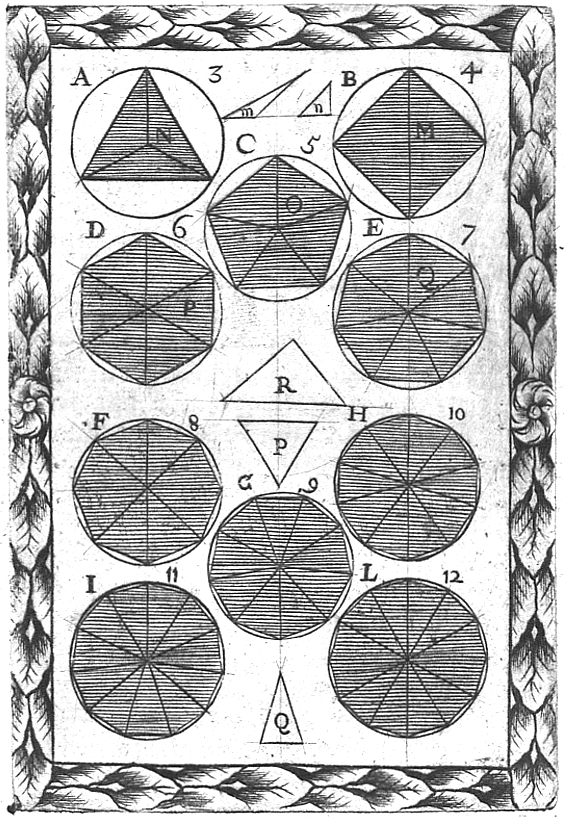
A tetracontagon, commonly called a 40-gon, is a polygon with forty straight sides and forty vertices. The name combines the Greek prefix "tetraconta-" (forty) with "-gon" (angle). The regular tetracontagon has equal sides and equal angles and is a useful theoretical example when studying polygonal approximations of the circle and symmetry groups. For a general introduction see related geometry resources.
Image gallery
3 Images
Basic properties
Key numerical facts for any tetracontagon include the sum of interior angles and the number of diagonals. The sum of interior angles is (40-2)·180° = 6,840°. Each interior angle of a regular tetracontagon measures 171° and each exterior angle is 9°. The number of distinct diagonals is n(n−3)/2 = 40·37/2 = 740.
Regular tetracontagon: formulas and symmetry
The regular 40-gon is denoted {40} in Schläfli notation. Side length s and circumradius R are related by s = 2R·sin(π/40). The area of a regular tetracontagon with side s can be written as A = (40·s²)/(4·tan(π/40)) = 10·s²/ tan(π/40). Its full symmetry group is the dihedral group D40 of order 80, with a cyclic rotation subgroup C40.
Constructibility and star polygons
By the classical criterion of Gauss and Wantzel, a regular n-gon is constructible with straightedge and compass precisely when n = 2^k times a product of distinct Fermat primes. Because 40 = 2^3·5 and 5 is a Fermat prime, the regular tetracontagon is constructible. Regular star polygons also exist on the same 40 equally spaced vertices; common examples are {40/3}, {40/7} and other {40/k} where k is coprime to 40, producing a family of star figures with their own visual and combinatorial properties.
Uses and notable facts
- Mathematical contexts: serves as an instructive example in polygon formulae, symmetry studies and constructibility proofs.
- Design and modelling: large-sided regular polygons approximate circles and appear in tiling patterns, decorative motifs and computational geometry.
- Distinction: an irregular tetracontagon has sides or angles that vary; only the regular form enjoys equal-angle properties, simple formulae and full dihedral symmetry.
The tetracontagon bridges elementary polygon geometry and more advanced topics like algebraic constructibility and group symmetry, making it a useful case study despite being uncommon in everyday objects.
Related articles
Author
AlegsaOnline.com Tetracontagon (40-sided polygon) Leandro Alegsa
URL: https://en.alegsaonline.com/art/97240