
Tenshō era (1573–1592): political consolidation and cultural change in Japan
Tenshō (天正, “Heavenly Virtue”) is the Japanese era from July 1573 to December 1592. It spans the fall of the Ashikaga shogunate, the rise of Oda and Toyotomi, major battles and cultural shifts in the Azuchi–Momoyama period.
Overview
Tenshō (天正), translated as "Heavenly Virtue," is a Japanese era name (nengō) that ran from July 1573 through December 1592. The era began after Genki and concluded before Bunroku. During Tenshō the imperial throne passed from Emperor Ōgimachi to Emperor Go‑Yōzei, while real political authority shifted among powerful warlords whose actions shaped the closing stages of the Sengoku period and the onset of the Azuchi–Momoyama era. For background on the system of era names see nengō.
Image gallery
4 Images

Political developments
This era witnessed the decisive decline of the Muromachi (Ashikaga) shogunate and the emergence of national unifiers. Oda Nobunaga played a central role early in the period, most notably by removing Ashikaga Yoshiaki from Kyoto in 1573 and asserting military dominance in central Japan. After Nobunaga's death in 1582 at Honnō‑ji, his general Toyotomi Hideyoshi avenged him and continued campaigns that brought most of the country under a single authority by the end of the decade.
Major events and campaigns
- 1573: Expulsion of Ashikaga Yoshiaki from Kyoto and effective end of the Ashikaga shogunate.
- 1575: Battle of Nagashino, where combined Oda‑Tokugawa forces overcame Takeda cavalry.
- 1582: Honnō‑ji Incident — Oda Nobunaga's assassination and the subsequent struggle for power.
- 1583–1590: Battles and sieges that consolidated Toyotomi Hideyoshi's control, including Shizugatake, Komaki‑Nagakute, the Kyūshū campaign, and the Siege of Odawara.
- 1587–1588: Social policy measures such as the sword‑hunt edicts and moves to regulate land and military resources.
Culture, religion and international contacts
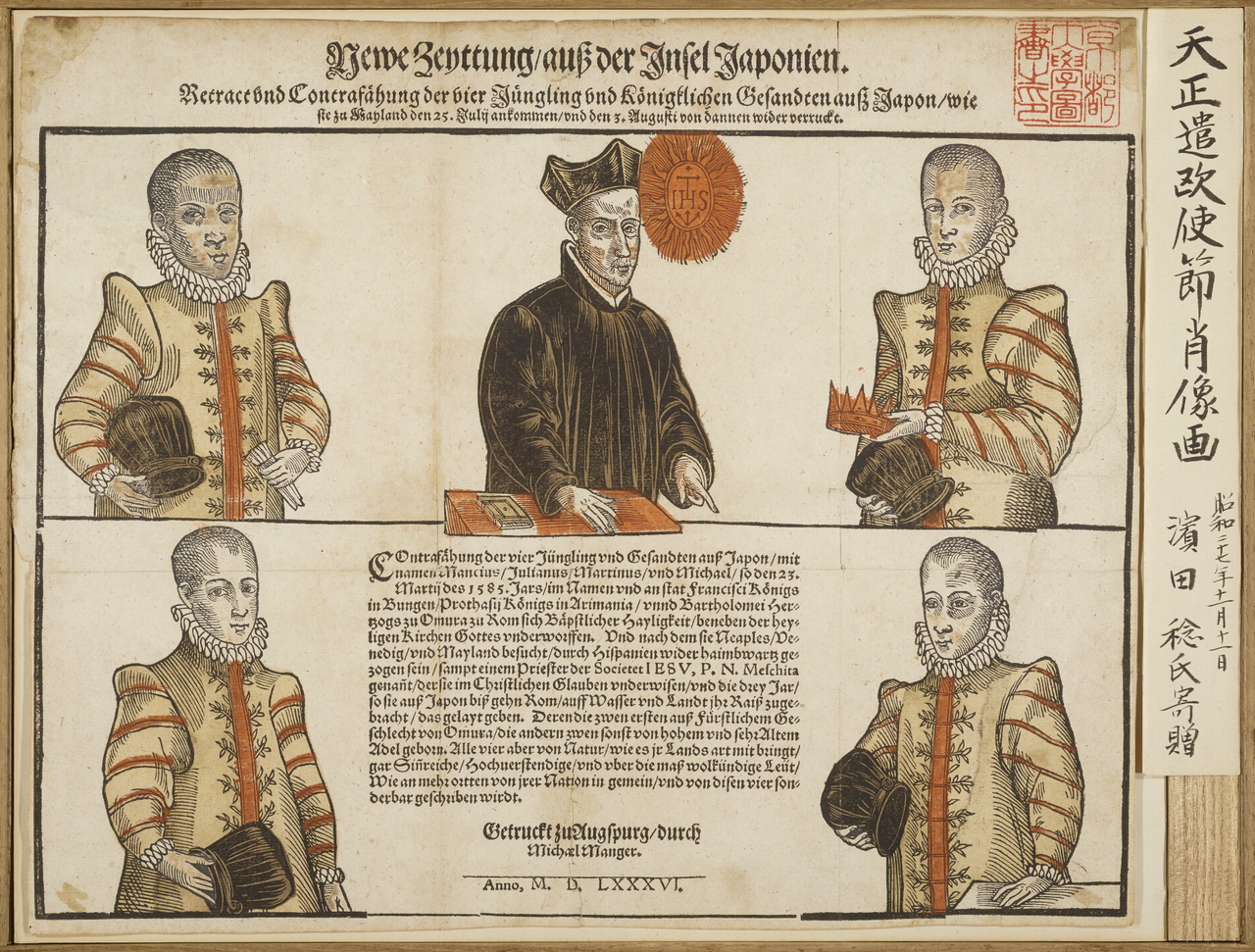
Tenshō was also a period of intense cultural activity. Castle construction reached new heights with grand residences and fortifications reflecting the tastes of the era. The tea ceremony matured under figures such as Sen no Rikyū, whose aesthetics deeply influenced court and warrior culture. At the same time, Christian missionaries remained active in western Japan and the Tenshō Embassy — a delegation of Japanese Christians sent to Europe in the 1580s — highlighted early global contacts.
Economy and administration
As warlords sought to govern larger territories they implemented administrative reforms: cadastral surveys, taxation measures and attempts to standardize currency and coinage were undertaken to stabilize revenues. Policies like disarming non‑samurai and organizing land surveys helped distinguish social classes and strengthen centralized control under Hideyoshi's rule.
Significance and transition
The Tenshō era marks the transformation from fractured regional warfare toward national unification and state building. It set political and cultural patterns that would shape Japan into the early modern period. By the close of Tenshō in 1592, the stage was set for continued centralization and for external ventures that would begin under the subsequent Bunroku era.
Related articles
Author
AlegsaOnline.com Tenshō era (1573–1592): political consolidation and cultural change in Japan Leandro Alegsa
URL: https://en.alegsaonline.com/art/97025
Sources
- books.google.com : Japan Encyclopedia
- books.google.com : Japan Encyclopedia
- books.google.com : Japan Encyclopedia
- books.google.com : Chikubushima: Deploying the Sacred Arts in Momoyama Japan
- books.google.com : The Making of Modern Japan
- books.google.com : The Cambridge History of Japan
- books.google.com : Nipon o dai itsi ran: ou Annales des empereurs du Japon
- books.google.com : Capitalscapes: Folding Screens And Political Imagination in Late Medieval Kyoto
- pweb.sophia.ac.jp : "When Four Boys Went to Meet the Pope, 400 Years Ago,"