
Tangent (geometry)
A tangent is a straight line that touches a curve at a point and shares its instantaneous direction. It formalizes the idea of 'touching' in geometry and calculus and is used for approximation and analysis.
In geometry, a tangent is commonly described as a line that touches a curve at a single point without crossing it in an infinitesimal neighborhood. More precisely, at the point of contact the line has the same instantaneous direction as the curve: the line shares the same slope or velocity vector there. Because of this coincidence of direction, the tangent provides the best linear approximation to a smooth curve near the point of tangency.
Image gallery
1 Image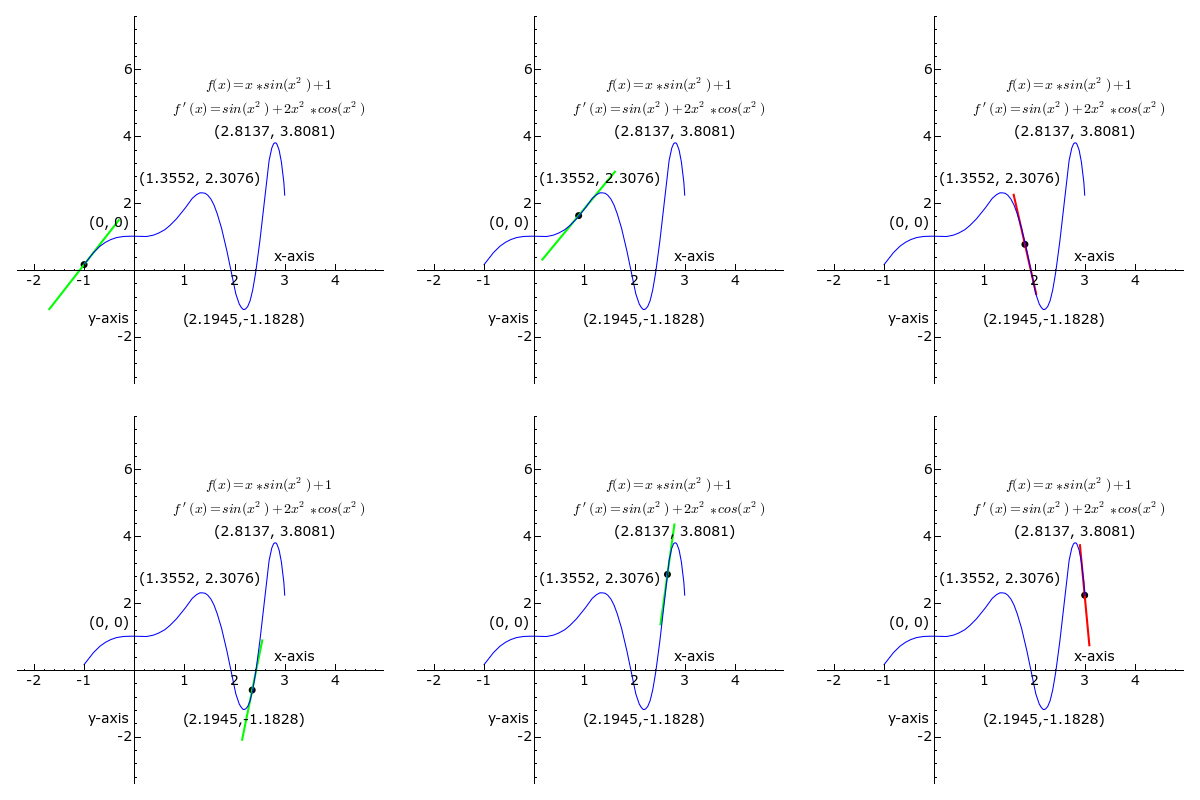
Characteristics and formal description
For a curve given by a differentiable function y = f(x), the tangent at x = a is the straight line through (a, f(a)) with slope f'(a). In classical geometry the tangent is obtained as the limiting position of a secant line joining two points on the curve as they merge. For parametric or implicitly defined curves the tangent direction follows from the derivatives of the component functions or from implicit differentiation. The line perpendicular to a tangent at the point of contact is called the normal.
History and development
Ideas of tangency appear in ancient Greek geometry, where tangent lines to circles and conic sections were studied. The concept gained a formal analytic foundation with the development of Cartesian coordinates and was given calculus-based rigor during the 17th century by thinkers who developed differential calculus. Those methods made it possible to compute tangent slopes for a wide variety of curves.
Examples and common properties
- Circle: a line tangent to a circle at a point is perpendicular to the circle's radius drawn to that point.
- Parabola: the tangent at a point gives a linear approximation used in many algebraic constructions and optical properties.
- Parametric curves: tangent direction equals the derivative vector; if the derivative vanishes additional analysis is required.
Uses, importance and noteworthy distinctions
Tangents are central in approximation (linearization), in defining instantaneous velocity in physics, and in optimization and differential geometry. They distinguish from secant lines (which meet a curve at two points) and from chords. A line that meets a curve at a point but also intersects it nearby may still be a tangent in the sense of sharing the same derivative; for algebraic curves this behavior is described by multiplicity of contact. Inflection points are locations where the tangent crosses the curve, and singular points require specialized tangent concepts.
Understanding tangents connects elementary Euclidean geometry with analytic and differential techniques, making the notion both a basic geometric relation and a fundamental tool across mathematics and its applications.
Related articles
Author
AlegsaOnline.com Tangent (geometry) Leandro Alegsa
URL: https://en.alegsaonline.com/art/96265