
Taylor's theorem: polynomial approximation and remainder forms
Taylor's theorem describes how a sufficiently differentiable function can be approximated near a point by a polynomial; it also gives formulas controlling the approximation error and conditions for convergence.
Taylor's theorem is a foundational result in analysis that explains how a smooth function can be approximated near a chosen point by a finite polynomial whose coefficients are built from the function's derivatives at that point. Those finite polynomials are called Taylor polynomials; the infinite limiting object, when it exists, is the Taylor series. The theorem gives both the explicit polynomial and formulas that bound or express the difference between the function and its polynomial approximation.
Image gallery
5 Images


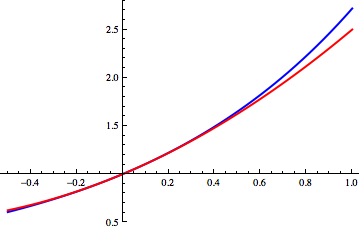
Statement and main elements
Fix a point a and suppose a function has derivatives up to order n in a neighborhood of a. The n-th order Taylor polynomial centered at a is the sum of terms involving derivatives at a multiplied by powers of (x minus a), each divided by the appropriate factorial. Taylor's theorem also supplies a remainder term that measures the approximation error. Common forms of the remainder include the Lagrange form, the integral form, and Cauchy's form; each expresses the error in a different but equivalent way under suitable hypotheses.
Remainder types and conditions
- Lagrange remainder: represents the error as a single derivative of order n+1 evaluated at an intermediate point, useful for explicit error bounds.
- Integral remainder: expresses the error as an integral involving the n+1-th derivative, often convenient for analysis and proofs.
- Cauchy form: a variant that interpolates between the Lagrange and integral expressions and can be advantageous in some estimates.
Convergence and analytic versus smooth functions
Having derivatives of all orders (smoothness) does not guarantee that the Taylor series converges to the original function. When the Taylor series does converge to the function on some interval, the function is called analytic on that interval. Examples show smooth non-analytic functions whose Taylor series converge only at the center point. Radius of convergence and behavior at boundary points are determined by the function's complex-analytic extension or singularities.
Uses, examples, and importance
Taylor polynomials are widely used for approximation in numerical computation, engineering, and theoretical estimates. Elementary examples include approximations of the exponential function, sine and cosine, and logarithms near convenient centers; these approximations underpin many algorithms and error analyses. Practical applications include series-based numerical methods, asymptotic expansions, and deriving linear or quadratic models in applied contexts.
History and references
The theorem bears the name of Brook Taylor, who gave early formulations in the early eighteenth century. Subsequent developments clarified the remainder expressions and the relation to infinite power series. For background on original formulations and formal proofs see the historical and mathematical expositions linked to the original statement, polynomial approximations, and the notion of a Taylor series: original statement, polynomial approximations, Taylor series.
Notable distinctions include the Maclaurin series, which is the special case centered at zero, and the difference between pointwise convergence of the series and equality of the sum with the function. Taylor's theorem remains a central tool for transferring local derivative information into usable algebraic approximations and rigorous error bounds.
Related articles
Author
AlegsaOnline.com Taylor's theorem: polynomial approximation and remainder forms Leandro Alegsa
URL: https://en.alegsaonline.com/art/96608