
Tanganyika (territory)
Tanganyika was the mainland African territory administered by Britain after WWI; it evolved from German East Africa to an independent state in 1961 and later united with Zanzibar to form Tanzania.
Overview
Tanganyika was a territory on the east African mainland that underwent several administrative changes in the 20th century. Located in Africa, it roughly corresponds to the continental portion of modern Tanzania (excluding the islands of Zanzibar and Pemba, but including Mafia). The territory took its name from Lake Tanganyika, which forms part of its western border.
Image gallery
4 Images

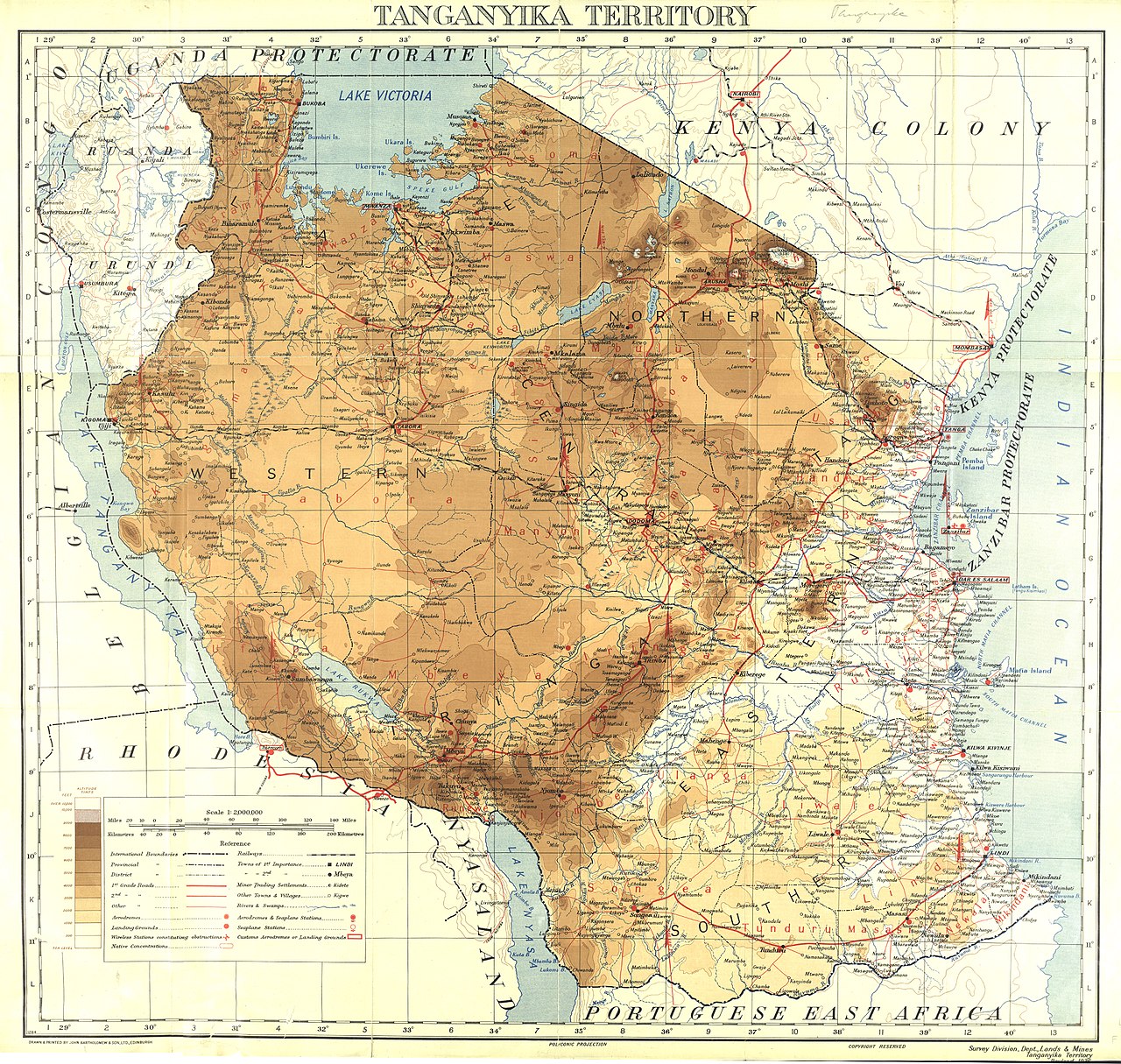

Geography and characteristics
Tanganyika comprised a large area of savanna, highlands and coastal plain, with diverse climates and ecosystems. Its interior included agricultural regions and the rift-valley lakes, while the Indian Ocean coast supported ports and trading towns. Ethnically and linguistically it was composed of many groups, with Swahili serving as a major lingua franca across different communities.
Colonial administration and legal status
Before World War I the region was part of German East Africa. British forces occupied the area during the war and after the conflict the former German possession was placed under international supervision. Tanganyika was administered by Great Britain first as a League of Nations mandate and later as a United Nations trust territory. Neighbouring parts of the former German colony—Rwanda and Burundi—followed a different path under Belgian administration.
Path to independence and union
Following a period of gradual political development and the growth of African political movements, Tanganyika achieved internal self-government and then independence in 1961. In 1964, shortly after independence, Tanganyika and the archipelago of Zanzibar agreed to unite, creating the United Republic of Tanzania. That union merged the mainland territory with the island sultanate to form the modern state commonly known today as Tanzania.
Economy, society and legacy
The economy of Tanganyika was historically based on agriculture, cash crops, and coastal trade, with rail and port links facilitating exports. Colonial administration left lasting impacts on land tenure, legal institutions and infrastructure, while post‑war political movements shaped nationalist aspirations. Tanganyika's transition from mandate to independent state is often cited in studies of decolonization in Africa.
Key facts and distinctions
- Origin: emerged from German East Africa after World War I and the reallocation of colonial territories.
- Administration: governed under international mandate and trust arrangements before full independence.
- Successor state: mainland Tanganyika formed the principal territory in the union that created present‑day Tanzania.
- Notable geography: named for and bordered by Lake Tanganyika, one of Africa's great lakes.
Tanganyika's history—colonial governance, nationalist movements and eventual union with Zanzibar—remains a central chapter in the modern political geography of East Africa and in narratives of decolonization on the continent.
Related articles
Author
AlegsaOnline.com Tanganyika (territory) Leandro Alegsa
URL: https://en.alegsaonline.com/art/96262