
Table tennis (Ping Pong): overview, equipment, history and gameplay
Table tennis, often called Ping Pong, is a fast racket sport played on a tabletop. This article explains equipment, basic play, history, organizations, and notable facts about the game.
Overview
Table tennis is a fast-paced indoor sport played either one-on-one (singles) or two-against-two (doubles) on a rectangular table divided by a low net. Often referred to colloquially as Ping Pong, the game emphasizes quick reflexes, spin control and tactical placement rather than sheer strength. It is played recreationally in homes and clubs and competitively at regional, national and international levels, making it a widely enjoyed activity around the world.
Image gallery
10 Images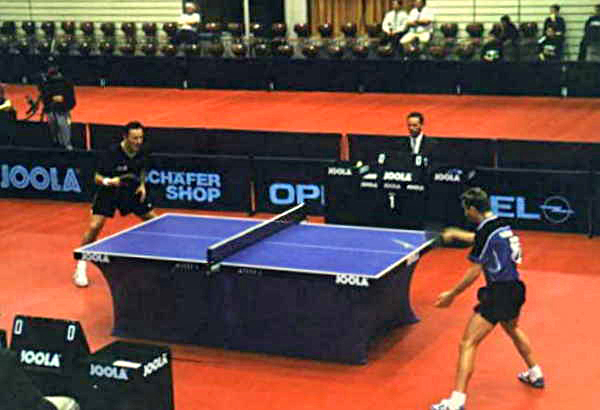



Equipment and basic play
Typical equipment includes a smooth, flat table, a net assembly, small lightweight balls and hand-held paddles (sometimes called bats or rackets). The standard ball is spherical and was traditionally made of celluloid; modern balls use non-celluloid plastics but share similar size and weight characteristics. Players serve and return the ball using alternating strokes; a rally continues until a point is scored when the ball bounces twice on a side, misses the table, or a rule infraction occurs. Matches are commonly organized as best-of series of games to a set number of points.
Key characteristics
- Table dimensions and net height are standardized for formal play.
- Paddles vary by rubber surface and sponge thickness, which affect spin and speed.
- Spin—topspin, backspin and sidespin—is a central tactical element.
- Formats include singles, doubles and team events at higher levels.
History and governance
Table tennis emerged in the late 19th century as an indoor parlor game and developed into an organized sport over subsequent decades. The international governing body, the International Table Tennis Federation (ITTF), was established in the 1920s to coordinate rules and competitions. Table tennis became an Olympic sport in the late 20th century, increasing its global profile and professional circuits. Many elite players and training programs are concentrated in a few countries, and high-performance athletes often come from long-established national systems in many countries.
Uses, importance and notable facts
Beyond competition, table tennis is used for fitness, social recreation and rehabilitation because it demands agility and hand-eye coordination without heavy physical contact. It is accessible to a wide range of ages and abilities. Notable facts include its trademarked nickname Ping Pong in some regions and the historical use of celluloid material for balls, often referenced in discussions of equipment evolution celluloid balls. The sport's combination of strategy, speed and precision makes it both spectator-friendly and widely practiced at grassroots levels.
Further reading
For official rules, event calendars and resources for new players, consult national federations and the sport's international governing body. Recreational clubs and community centers often offer introductory sessions and social play opportunities.
Related articles
Author
AlegsaOnline.com Table tennis (Ping Pong): overview, equipment, history and gameplay Leandro Alegsa
URL: https://en.alegsaonline.com/art/95804