
Tabla (Indian hand drum)
The tabla is a pair of tuned hand drums central to North Indian (Hindustani) music. This article covers its construction, playing techniques, historical background, repertory, and notable players and traditions.
The tabla is a pair of small hand drums used widely in North Indian (Hindustani) musical traditions and beyond. Typically played as a matched pair, the smaller right-hand drum produces higher-pitched, treble tones while the larger left-hand drum yields bass and resonant sounds. The instrument is closely associated with classical, popular, devotional, and film music in South Asia, and it has been adopted in many global fusion contexts. The name has cognates and variants across languages; for example, it appears in Bengali forms and is linked etymologically to older Arabic words for drum via cultural contact. For language and regional references see regional names and historical terminology in other sources such as Arabic and Persian materials.
Image gallery
5 Images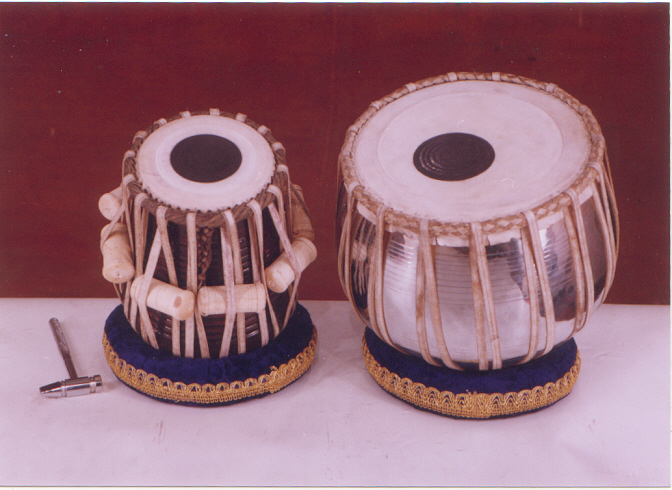


Construction and components
A tabla set consists of two separate drums. The treble drum (commonly called the dayan or tabla) is usually made of hardwood and has a smaller diameter; the bass drum (bayan or duggi) is often made of metal, clay, or wood and has a larger head. Each drum head is a layered membrane with a central black paste called the syahi (or gub), which helps produce distinct harmonic overtones and the characteristic ringing and clear pitch of many strokes. Tensioning straps or a metal rim allow the player to tune the instrument; many players also use a tuning hammer to adjust the wooden blocks that change head tension.
Playing technique and vocabulary
Tabla technique emphasizes finger and palm articulation, precise timing, and a spoken-syllable vocabulary called bols that represent distinct strokes. Players produce a wide range of sounds by varying where the hand strikes the head, which fingers are used, and whether the palm slides or mutes the surface. Typical stroke categories include resonant clear notes, muted taps, bass slides, and combinations that mix treble and bass tones in quick succession. Learning traditionally involves memorizing and vocalizing bols while developing hand coordination and rhythmic cycles.
Repertoire, forms and role in music
In performance the tabla serves both as an accompanying instrument and as a solo vehicle. In accompaniment it supports vocalists, instrumentalists, and dancers by articulating tala (rhythmic cycles) and by marking tempo and musical phrases. As a solo instrument, tabla repertoire includes composed and improvised forms such as kaida, rela, gat, tukra and paran; these forms present set patterns that a performer elaborates on with variations and improvisation. The tabla is important in Hindustani classical concerts, light classical genres, devotional music, and in many popular and film contexts in South Asia, and it is also played by musicians in Pakistan and Afghanistan and by international artists.
History and development
The tabla is widely considered to have developed from older Indian drum traditions, such as the two-headed pakhawaj, and through contact with Central Asian and Middle Eastern percussion practices. Over the centuries it evolved in form, tuning, and technique to suit the aesthetic demands of northern Indian music. Scholars and musicians trace the consolidation of modern tabla technique to several influential lineages and schools known as gharanas; these lineages passed down compositions, fingerings, and stylistic emphases through teacher–student relationships.
Gharanas and notable players
Several gharanas (stylistic schools) have shaped tabla playing, each emphasizing particular repertoires and technical approaches. Among the well known are the Delhi, Punjab, Lucknow, Farrukhabad, Ajrada and Banaras traditions, although many contemporary players study across multiple gharanas. Prominent modern tabla masters have brought the instrument international recognition: for example, Ustad Zakir Hussain, associated with the Punjab gharana, is widely celebrated for virtuosity and cross-genre collaborations, and other accomplished players have extended the instrument’s reach into different musical cultures. For performances and artist profiles see links such as live performances and regional musician pages like Pakistani tabla traditions.
Teaching, notation and global presence
Traditionally taught through oral transmission, tabla pedagogy uses bols and demonstration; in recent decades, notation systems and recordings have supplemented teaching. The tabla is now found in conservatories and world-music ensembles around the globe, often paired with melodic instruments or electronic media, and it continues to inspire new compositional and improvisatory approaches. General instrument family information can be found in overviews of percussion instruments and comparisons with similar hand drums at resources like percussion families.


Related articles
Author
AlegsaOnline.com Tabla (Indian hand drum) Leandro Alegsa
URL: https://en.alegsaonline.com/art/95794
Sources
- world-of-tabla.com : "Tarang's World of Tabla"
- chandrakantha.com : "Basic Overview of the Tabla"
- zakirhussain.com : "Zakir Hussain"