
Supply and demand: the basic economic model of price formation
An encyclopedia overview of supply and demand: how prices form from producers and consumers, equilibrium, shifts vs movements, elasticity, history, examples, and policy limits.
Overview
The concept of supply and demand is a foundational model in microeconomics that explains how prices and quantities are determined in many markets. In its simplest form the framework describes how the willingness of sellers to offer goods and services and the willingness of buyers to acquire them interact to establish a market price and traded quantity. The analysis normally assumes a market economy in which many independent buyers and sellers engage voluntarily.
Image gallery
8 Images



Basic principles
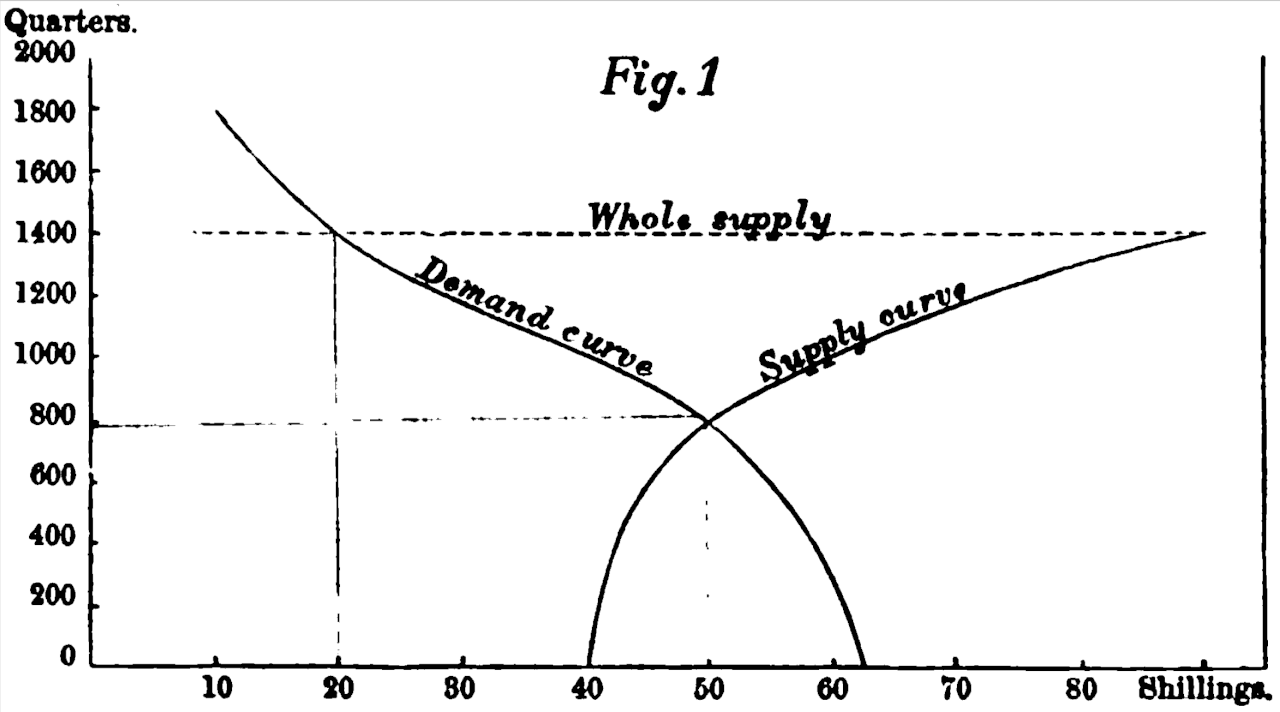
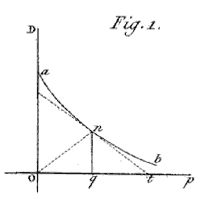
Two core relationships underpin the model. The law of demand states that, other things equal, the quantity demanded falls when price rises and rises when price falls. The law of supply states that the quantity supplied tends to increase when price rises and decrease when price falls. Equilibrium occurs when the quantity that producers supply equals the quantity that consumers demand; in idealized settings this is called the equilibrium market price. Deviations from equilibrium produce shortages or surpluses and pressure prices to adjust.
Shifts, movements and common laws
Analysts distinguish between a movement along a curve (a change in quantity demanded or supplied caused by a price change) and a shift of the whole curve (a change in demand or supply at every price). For typical goods the following outcomes are expected:
- If demand rises while supply is unchanged, prices tend to rise and quantities increase.
- If demand falls with constant supply, prices tend to fall and quantities decrease.
- If supply increases with constant demand, prices tend to fall and quantities increase.
- If supply decreases with constant demand, prices tend to rise and quantities decrease.
Determinants and elasticity
Non‑price factors that shift demand include incomes, tastes, expectations, and the number of buyers. Supply shifts are driven by input costs, technology, taxes or subsidies, and the number of sellers. The sensitivity of quantity to price is summarized by elasticity. Price elasticity of demand measures how much quantity demanded responds to a price change; goods that are necessities or have few substitutes are typically less elastic. Elasticities help predict revenue, tax incidence and how large a price change will affect traded quantities.
History and development
The intuitive idea that prices reflect scarcity and desire predates formal economics, but supply and demand were brought into systematic use by classical and nineteenth‑century economists and later refined in textbooks and graphical form. Early modern treatments emphasized market forces and comparative statics; subsequent work extended the framework to general equilibrium, welfare analysis and game‑theoretic models. The simple two‑curve diagram remains a standard pedagogical tool for introducing market behavior.
Applications, examples and limitations
Supply and demand explain routine price fluctuations in goods such as fuel, food and housing, and they underpin analyses of labor markets and financial assets. The model also informs policy choices: for example, how a sales tax, subsidy or price ceiling affects market outcomes. However, the basic model has limits. Markets with few sellers or buyers depart from the perfect competition ideal; public goods, externalities and information problems can prevent efficient outcomes; and rigidities may hinder price adjustment. When markets deviate from assumptions, supplementary tools are required to capture real‑world complexity.
In applied discussions it is useful to note related concepts: the processes that drive supply increases as new suppliers enter and production scales up, pushing prices toward marginal cost and affecting the cost of production. Distribution networks and logistics influence how changes at the producer level translate into shelf prices, which is linked to distribution. For further introductions and visualizations of the basic diagrams and comparative statics, readers can consult standard textbooks and accessible online primers.
For concise reference on particular terms and extensions: see entries on supply, demand, market price, the role of producers and consumers, the model as an analytical model of microeconomics, and the conditions of perfect competition. These concepts form the starting point for many applied and policy discussions regarding market behavior and economic welfare.
Related articles
Author
AlegsaOnline.com Supply and demand: the basic economic model of price formation Leandro Alegsa
URL: https://en.alegsaonline.com/art/95103