
Stefan–Boltzmann law
Physical law stating that an ideal blackbody emits energy per unit area proportional to the fourth power of its absolute temperature: R = σT^4. Important in thermodynamics, astrophysics and radiative heat transfer.
Overview
The Stefan–Boltzmann law is a fundamental result in thermal radiation stating that the total power radiated per unit surface area of an ideal blackbody is proportional to the fourth power of its absolute temperature. In compact form the law is written as R = σ T^4, where R is the radiative flux (power per unit area), T is temperature measured on the Kelvin scale, and σ is the Stefan–Boltzmann constant (approximately 5.67×10^-8 W·m^-2·K^-4).
Image gallery
1 Image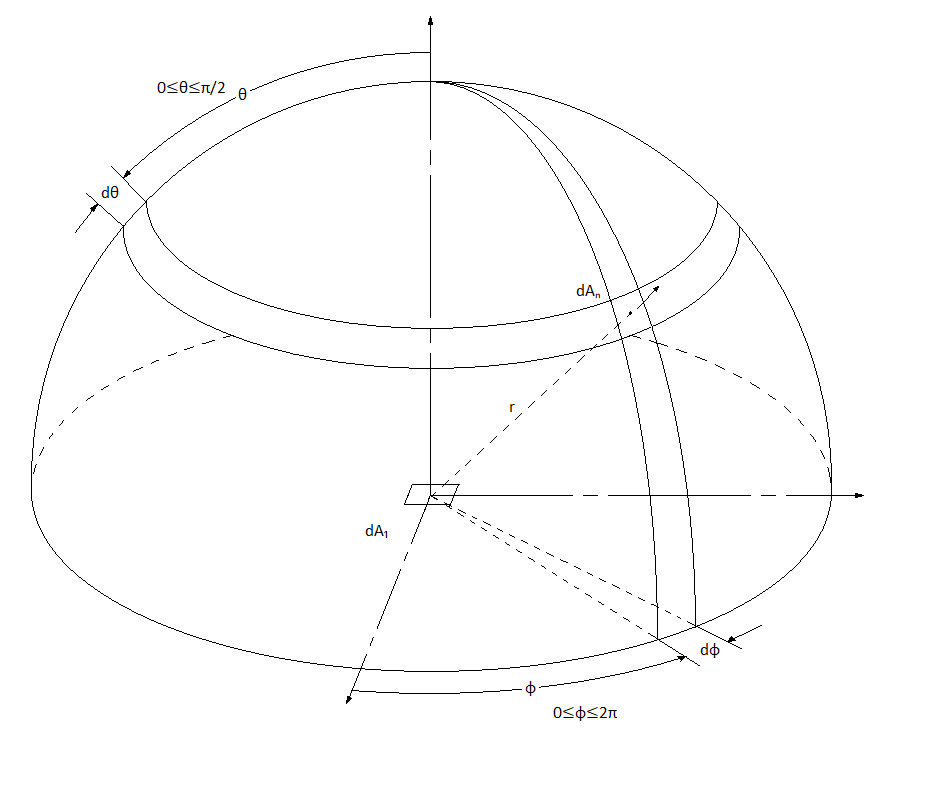
Mathematical form and practical modifications
For a perfect blackbody the emitted power per unit area is R = σ T^4. Real surfaces do not radiate as perfectly; their emission is reduced by an emissivity factor ε (0 ≤ ε ≤ 1). For such a surface the net emitted power is commonly written R = ε σ T^4. For extended objects like stars, total luminosity follows L = 4πR^2 σ T^4, where R is the object radius.
Origin and theoretical basis
The law was formulated empirically by Josef Stefan in the late 19th century and given a theoretical foundation by Ludwig Boltzmann via thermodynamic arguments. Later, quantum mechanics and Planck's law provided a rigorous derivation: integrating Planck's spectral radiance over all wavelengths and solid angle yields the T^4 dependence and the value of σ.
Applications and examples
- Astrophysics: estimating stellar luminosities and effective temperatures from observed radiative flux.
- Climate and Earth science: assessing outgoing longwave radiation and energy balance at planetary surfaces.
- Engineering: radiative heat transfer calculations in furnaces, thermal insulation, and infrared thermometry.
- Laboratory physics: calibrating blackbody sources and thermal detectors.
Limitations and notable distinctions
The Stefan–Boltzmann law applies strictly to bodies in thermal equilibrium that behave as blackbodies or as gray bodies with known emissivity. It does not describe spectral distribution (which is given by Planck's law) nor radiation from non-thermal processes. Surface emissivity can vary with wavelength and direction, and the law assumes an optically thick, uniform-temperature emitter. In practice, corrections are needed for layered materials, semitransparent media, or objects with significant temperature gradients.
Related articles
Author
AlegsaOnline.com Stefan–Boltzmann law Leandro Alegsa
URL: https://en.alegsaonline.com/art/93651