
String (theoretical physics)
One-dimensional vibrating objects postulated by string theory to replace point particles; their modes and interactions aim to unify quantum mechanics and gravity but remain experimentally unconfirmed.
Overview
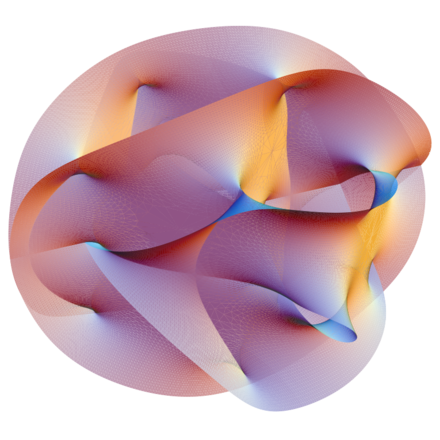
Image gallery
1 Image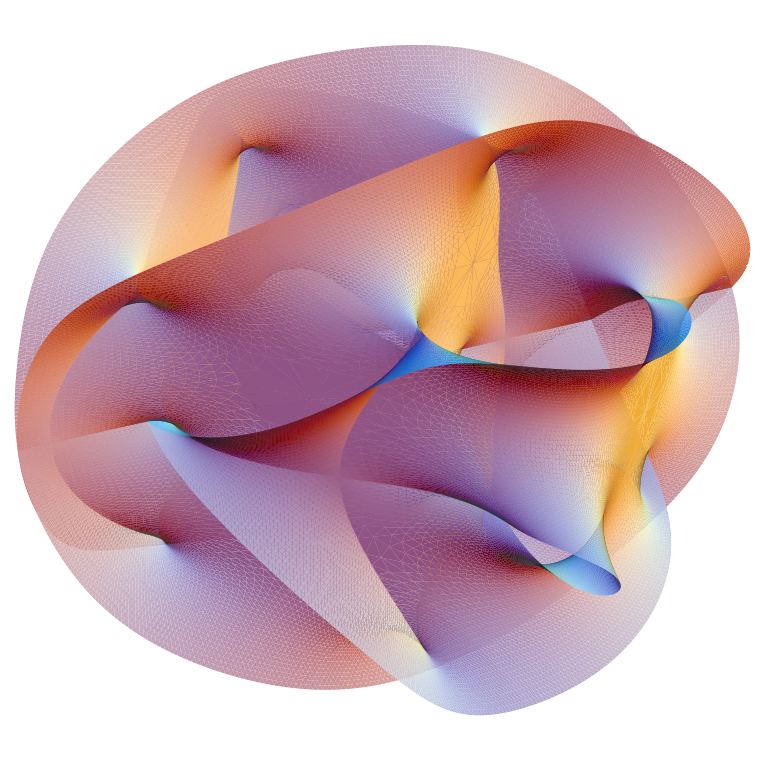
Key characteristics
Strings are fundamentally one-dimensional and may be either open (with two endpoints) or closed (forming loops). Important qualitative features include:
- Vibrational spectrum: The quantized vibrational excitations of a string map to a spectrum of particle-like states.
- Modes and interactions: Interactions are represented by splitting and joining of strings rather than point collisions.
- Extra dimensions: Consistent formulations require additional spatial dimensions beyond the familiar three; these are typically compactified or otherwise hidden from low-energy physics. See discussions of dimensions in theoretical models.
- Scale: Characteristic string length is expected to be extremely small, at or near the Planck scale, where quantum gravity effects become significant.
Historical development
The concept of strings emerged in the late 1960s and early 1970s from models of the strong interaction, later evolving into a candidate for a unified quantum theory of gravity when researchers found that certain string models include a massless spin-2 state with the properties of a graviton. Over subsequent decades the framework expanded to include supersymmetric versions (superstrings), five consistent string theories in ten spacetime dimensions, and the conjectured unifying framework called M-theory that suggests an eleven-dimensional description. These developments are foundational to ongoing research in quantum gravity and high-energy theory.
Significance, applications, and examples
Although strings themselves have not been observed, the framework has influenced many areas of theoretical physics. Notable contributions include insights into black hole entropy, dualities connecting gauge theories to gravity (for example, the AdS/CFT correspondence), and mathematical connections to geometry and topology. String models give a unified language for describing different particle types and interactions, treating forces and matter on a common footing through vibrational modes and extended objects such as higher-dimensional branes.
Distinctions and technical points
It is important to distinguish between several usages of the word "string": in one sense it denotes a candidate fundamental entity; in another it may describe an effective or emergent excitation in a particular physical regime. The formalism also includes additional objects (branes) and mechanisms (compactification, dualities) that determine how four-dimensional physics arises from higher-dimensional models. Open strings can end on branes, while closed strings include modes associated with gravity.
Experimental status and open questions
To date there is no direct experimental evidence for strings. Predicted effects typically occur at energies far above those accessible to current accelerators, which leaves the hypothesis difficult to confirm or refute directly. Research continues on possible low-energy signatures, mathematical consistency, and connections to observable phenomena. Major open questions include the correct way to connect string constructions to the Standard Model of particle physics, the mechanism that fixes the shape and size of extra dimensions, and whether the theory yields definitive, testable predictions.
For introductions and reviews of basic concepts readers may consult general treatments of string theory, accounts of elementary particle physics like descriptions of elementary particles, discussions of energy and scales in physics via energy, and resources on compactified dimensions.
Questions and answers
Q: What are strings?
A: Strings are hypothetical objects that are believed to be the elementary particles of the universe. If they exist, they would not be point-like particles, but rather 1-dimensional "strings" of energy that vibrate in various dimensions.
Q: How many dimensions does our universe have?
A: Physicists accept the fact that there are at least 11 dimensions in our universe: 1 time dimension and 10 spatial dimensions.
Q: What is Planck length?
A: Planck length is a unit of measurement used to determine the length of strings. It is calculated by taking the square root of hbar times G divided by c cubed (e_p=sqrt(hbar*G/c^3)).
Q: Is it known whether these strings actually exist?
A: It is still not known whether these strings actually exist. They are pretty much the main topic of string theory.
Q: What type of particle would strings be if they existed?
A: Strings would not be point-like particles, but rather 1-dimensional "strings" of energy that vibrate in various dimensions.
Q: How do physicists measure string lengths?
A: The length of the strings would be determined by Planck length, which is calculated by taking the square root of hbar times G divided by c cubed (e_p=sqrt(hbar*G/c^3)).
Q: What is string theory about?
A:String theory is about determining whether or not these strings actually exist - they are pretty much the main topic of string theory.
Related articles
Author
AlegsaOnline.com String (theoretical physics) Leandro Alegsa
URL: https://en.alegsaonline.com/art/94289