
Span (unit of length)
An anthropic unit based on the human hand: the span measures the distance between the thumb and little finger and has varied historically; commonly cited as about 9 inches (0.2286 m).
Overview
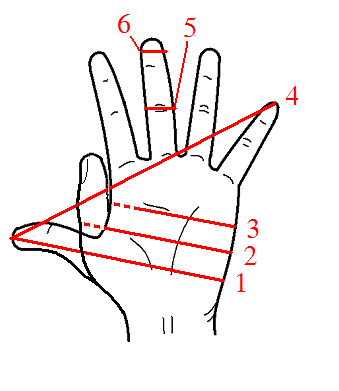
The span is a traditional, anthropic unit of length defined as the distance across an outstretched human hand from the tip of the thumb to the tip of the little (pinky) finger. It belongs to a family of body-based measurements that include the foot, cubit, and hand. Because it is based on living anatomy, the exact size of a span varies with age, sex, and individual build.
Image gallery
2 Images
Typical measurement and conversion
In many English-language sources a span is commonly given as about nine inches. This value is often cited as an approximate standard and can be expressed as roughly 0.2286 metres. For practical purposes one may write: 1 span ≈ 9 in and 1 span ≈ 0.2286 m. Individual hands differ, so the span is best treated as an approximate or informal unit rather than a precise standard.
History and cultural variants
Body-based measures have existed in most societies because they are convenient and require no tools. The span was used in everyday tasks, tailoring, and simple construction before metrification and uniform standards. Various cultures developed related measures with slightly different definitions and names. For example, in several Slavic languages a related notion is the pyad (пядь), traditionally measured from the tip of the thumb to the tip of the forefinger rather than the little finger. Modern linguistic and historical references discuss these units as part of broader systems of pre-standard measurement.
Uses, examples and practical context
The span served as a quick rule-of-thumb for rough measuring: estimating cloth width, small carpentry layouts, or distances in everyday life. An adult's hand span often ranges between about 8 and 10 inches, so a person wishing to estimate a length could use several spans laid end to end. Contemporary usage is largely descriptive or historical rather than technical.
Relations and distinctions
- The span is roughly half of a common cubit (a cubit is traditionally the length from elbow to fingertip, often about 18 inches);
- It is larger than a "hand" as used for measuring horses (a hand = 4 inches) and smaller than a foot (12 inches);
- Different cultures have parallel units—names, definitions and exact sizes vary.
Further notes
When encountering the term in historical documents, it is important to check local definitions and context. For modern comparison or conversion, the widely quoted value of nine inches is a convenient reference but not a universal law. For more general information about the anatomy-based measure see human hand references, or consult conversion resources such as the page for 9 inches and metric equivalents like 0.2286 m. For details on Slavic terminology and the analogous measure see pyad and related terms.
Related articles
Author
AlegsaOnline.com Span (unit of length) Leandro Alegsa
URL: https://en.alegsaonline.com/art/92462