
Southbridge (computing): the motherboard I/O controller
Southbridge is the motherboard chipset component that manages lower-speed input/output functions—storage, USB, audio, power and legacy interfaces—distinct from the northbridge/CPU-facing logic.
Southbridge is the common name for the portion of a PC chipset responsible for handling many of the system's input/output (I/O) functions. It is often called an Input/Output Controller Hub (ICH) in Intel terminology. The southbridge works together with the northbridge to form the traditional two-part chipset on a motherboard, but unlike the northbridge it is not directly connected to the central processor.
Image gallery
1 Image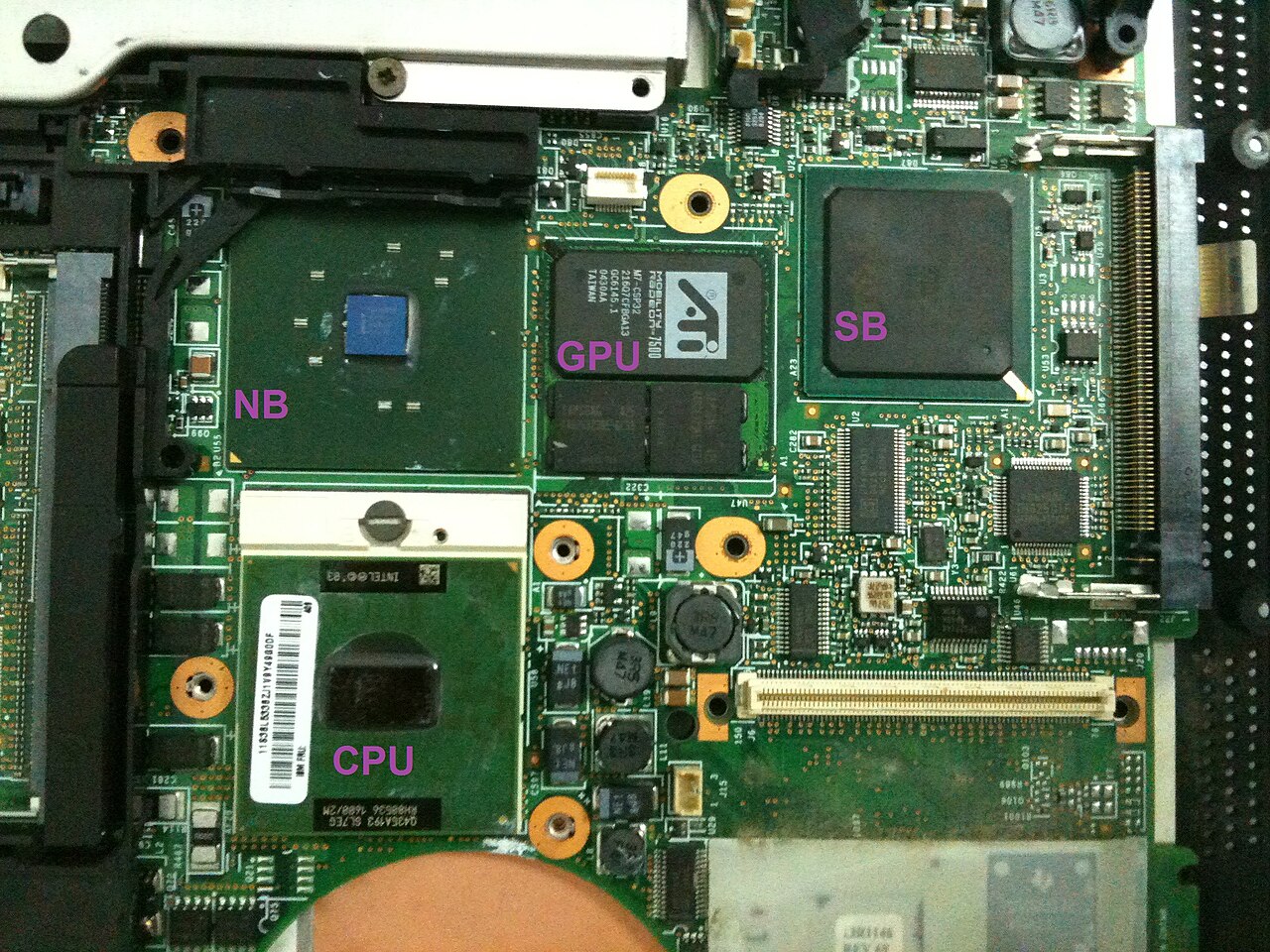
Primary responsibilities
The southbridge typically manages lower-bandwidth peripherals and platform services that do not require the high-speed connection to the CPU or main memory. Common responsibilities include:
- Storage interfaces such as SATA and legacy IDE/ATA controllers.
- USB host controllers and other external device buses.
- Onboard audio and legacy serial/parallel ports, often mediated by a Super I/O companion chip.
- System firmware support (BIOS/UEFI), real-time clock and CMOS settings.
- Power management and platform control governed by ACPI.
- Low Pin Count (LPC) bus and management of devices like TPM and embedded controllers.
Historical development
In classic PC architecture the chipset was split into northbridge and southbridge: the northbridge linked the CPU, RAM and graphics, while the southbridge provided I/O. Over time, functions that required very high throughput — notably the memory controller and some PCI Express connectivity — migrated into the CPU or a single-chip solution. Intel labeled its southbridge implementations as ICH and later consolidated roles into a Platform Controller Hub (PCH). AMD used comparable terminology for its southbridge chips in its chipset families.
Relationship with the northbridge
The southbridge communicates with the CPU indirectly, typically via the northbridge or a dedicated interconnect. This separation reflects a performance-driven design: components needing low latency and high bandwidth (CPU, RAM, GPU interfaces) were grouped apart from relatively lower-speed I/O. For more on the northbridge role, see northbridge.
Modern context and importance
Modern motherboards and system-on-chip (SoC) designs have blurred the traditional boundaries. Many southbridge functions remain essential even when integrated into a single chip: managing storage devices, external ports, firmware, and system management tasks. Understanding the southbridge concept helps explain why some peripherals behave differently and why motherboard chipsets are marketed by their I/O capabilities and port support.
Notable facts: while the explicit "southbridge" label is less common in advertisements today, the set of services it provided continues under names like "chipset south-cluster" or "PCH" and remains central to the computer's ability to connect peripherals and manage platform features.
Related articles
Author
AlegsaOnline.com Southbridge (computing): the motherboard I/O controller Leandro Alegsa
URL: https://en.alegsaonline.com/art/92259