
Soest (district)
Kreis Soest is an administrative district in central North Rhine-Westphalia, Germany, centered on the historic town of Soest and including a mix of towns, rural areas and nature reserves.
Soest (district) is a Kreis (administrative district) in central North Rhine-Westphalia, Germany. The district is organised around the historic town of Soest, which serves as its administrative seat. It combines urban centres, market towns and countryside and lies near larger metropolitan areas while retaining a distinct regional identity.
Image gallery
1 Image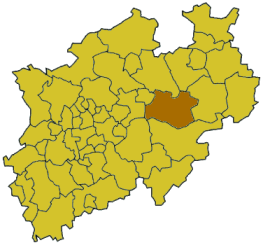
Geography and municipalities
The district covers a varied landscape of fertile lowlands, river valleys and wooded uplands. It includes several towns and municipalities, among them Soest itself and other notable places such as Lippstadt, Werl, Warstein, Bad Sassendorf and Möhnesee. Natural features and reservoirs within or close to the district provide areas for recreation and nature conservation.
History and development
The communities in the district have medieval roots, with many towns preserving historic centres, churches and market squares. Over centuries the area developed as a regional trading and agricultural hinterland. Modern administrative boundaries evolved through nineteenth- and twentieth-century reforms; the district in its present form was shaped by postwar regional reorganisations.
Economy and transport
The local economy mixes agriculture, small and medium-sized industries, service businesses and tourism. Manufacturing and craft enterprises coexist with farms and retail. Transport links include regional rail services and road connections that tie the district to neighbouring urban areas, facilitating commuting and commerce.
Culture, tourism and recreation
Visitors are drawn to the district for its well-preserved townscapes, traditional markets and cultural events. Outdoor opportunities range from lakeside recreation to hiking and cycling in nearby forests and nature parks. Local museums and historic churches present the area’s heritage.
Notable distinctions
- Administrative seat in the historic town of Soest, known for its medieval core.
- Combination of urban centres and rural landscape makes the district a transition zone between densely populated regions and upland nature areas.
- Accessible from larger West German conurbations while offering distinct local character and recreational sites.
For more detailed, up-to-date administrative or visitor information consult regional resources and official portals.
Related articles
Author
AlegsaOnline.com Soest (district) Leandro Alegsa
URL: https://en.alegsaonline.com/art/91554