
Selenium — properties, uses, biological role and history
Selenium (Se, Z=34) is a chalcogen element with semiconductor and photoconductive properties, essential in trace amounts for life, used in glass, electronics and solar technology; toxic at higher doses.
Selenium is a chemical element first identified in the early 19th century. It is represented by the symbol Se and has atomic number 34. In atomic terms selenium contains 34 protons and 34 electrons, and its standard atomic mass is about 78.96. For a general definition see chemical element.
Image gallery
10 Images
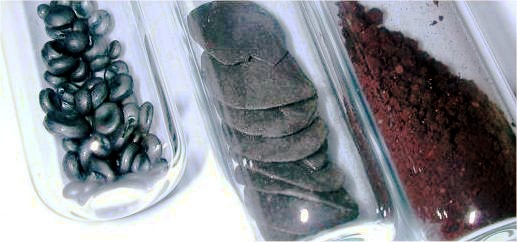


Characteristics and forms
Selenium belongs to group 16 of the periodic table, the chalcogen family, alongside sulfur and tellurium. It exhibits several allotropes: a shiny, gray metallic form that behaves like a semiconductor; red allotropes that are amorphous; and glassy black forms. The element is brittle in bulk and becomes more conductive when exposed to light, a property called photoconductivity.
Occurrence and production
In nature selenium is relatively rare and is usually found combined with sulfide minerals, often accompanying copper, lead and nickel ores. Commercial selenium is typically recovered as a byproduct of refining these metal sulfide concentrates. Refined selenium is produced in small quantities compared with major industrial metals.
Uses and applications
- Glassmaking: selenium compounds are used to decolorize glass or to produce red and pink pigments.
- Electronics and photovoltaics: selenium's photoconductive behavior has found historical use in photocopiers, light meters, rectifiers and some solar cells.
- Metallurgy and chemicals: added to alloys and chemicals to improve machinability or to assist in chemical syntheses.
- Agriculture and nutrition: small amounts are added to animal feed or fertilizers where soils are selenium-deficient.
Biological role and toxicity
Selenium is an essential trace element for many organisms, including humans. It is a component of selenoproteins such as glutathione peroxidases and plays a role in antioxidant defense and thyroid hormone metabolism. However, the margin between dietary deficiency and toxicity is relatively narrow: excess intake can cause selenosis, with symptoms like hair loss, nail brittleness and neurological effects.
History and notable facts: Selenium was identified by Jöns Jacob Berzelius in 1817 and its name derives from the Greek word for moon, selene, because of its chemical relation to tellurium (named for Earth). Its unique combination of chemical similarity to sulfur and semiconducting, photoconductive behavior makes selenium important in both chemistry and materials science.
For further detailed specifications, safety data and industrial standards, specialized technical sources and regulatory guidance should be consulted.
Related articles
Author
AlegsaOnline.com Selenium — properties, uses, biological role and history Leandro Alegsa
URL: https://en.alegsaonline.com/art/88662
Sources
- science.howstuffworks.com : "Selenium"
- wikidata.org : wikidata.org/wiki/Q876
- catalogo.bne.es : XX534324
- catalogue.bnf.fr : cb121383271
- data.bnf.fr : (data)
- d-nb.info : 4180872-1
- id.loc.gov : sh85119688
- id.ndl.go.jp : 00570819