
Selenate (SeO4^2−)
Selenate is the tetrahedral oxyanion of selenium in its highest common oxidation state. This article summarizes its structure, chemistry, uses, environmental behaviour and safety considerations.
Overview
Selenate refers to the oxyanion with the formula SeO4^2−. It is the fully oxidized form of selenium commonly encountered in inorganic chemistry and environmental systems. Selenate salts are typically water-soluble and the ion is chemically and structurally analogous to the sulfate ion (SO4^2−), sharing a tetrahedral geometry centered on selenium in a high oxidation state.
Image gallery
1 Image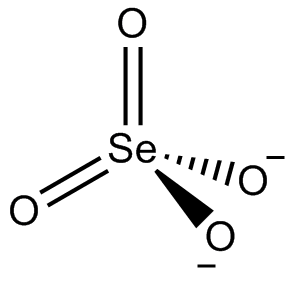
Structure and properties
The selenate ion is a tetrahedral anion with selenium formally in the +6 oxidation state bonded to four oxygen atoms. Many simple alkali and alkaline earth metal selenates dissolve readily in water to give free SeO4^2− ions. Compared with lower-valence selenium oxyanions (for example selenite, SeO3^2−), selenate is generally less easily reduced and can act as an oxidizing agent under suitable conditions.
Chemistry and reactions
Under strongly acidic conditions selenate is protonated to form selenic acid (H2SeO4); see selenic acid for more. Reduction of selenate yields selenite or elemental selenium, processes that occur in both chemical and biological systems. In redox chemistry it can accept electrons from reducing agents and has been used in laboratory oxidations and analytical contexts; for background on oxidizing reagents see oxidizing agents.
Examples and common salts
Representative selenate salts include sodium selenate, potassium selenate and ammonium selenate. Sodium selenate is a widely cited example; product and material data are available in specialized references such as sodium selenate. For a general definition of ionic species see ion.
Uses, environmental behaviour and biology
Selenate is relevant in agriculture and environmental chemistry because it is relatively mobile in soils and readily taken up by plants compared with some other selenium forms. This mobility makes selenate useful in fertilisers and micronutrient supplements but also raises concerns about leaching and toxicity when concentrations are elevated. In biology selenium is an essential trace element, yet excessive intake of soluble selenate salts can be harmful.
Safety and distinctions
Handling selenate compounds requires attention to dose and exposure. They should be distinguished from selenite (SeO3^2−) and organoselenium species, which differ in reactivity and bioavailability. Laboratory and industrial use follows standard precautions for oxidizing and potentially toxic inorganic salts.
- Related ions: selenite (SeO3^2−), tellurate (TeO4^2−)
- Representative salts: Na2SeO4, K2SeO4, (NH4)2SeO4
Related articles
Author
AlegsaOnline.com Selenate (SeO4^2−) Leandro Alegsa
URL: https://en.alegsaonline.com/art/88650