
Bananas (1971 film)
A 1971 political satire directed by and starring Woody Allen. The comic film follows a neurotic New Yorker entangled in a Latin American revolution and is noted for its surreal gags and mock-documentary sequences.
Bananas is a 1971 American political comedy written, directed by and starring Woody Allen. The film blends slapstick, absurdist set pieces and topical satire to tell the story of a nervous New Yorker who becomes improbably involved in the politics of a fictional Latin American republic. Released by United Artists, it is one of Allen's early features that helped define his screen persona of anxious wit and neurotic charm.
Image gallery
1 Image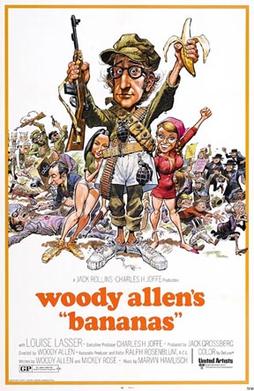
Plot and structure
The narrative follows a hapless protagonist who looks for personal reinvention and romantic approval by taking an extreme detour into revolutionary politics. Rather than a straightforward political thriller, the film uses episodic sketches, quick-cut montages and faux newsreel material to lampoon both revolutionary rhetoric and U.S. cultural pretensions. Tonally it alternates between physical comedy and pointed parody, often abandoning conventional plot continuity for comic effect.
Cast and production
Alongside Allen, the principal cast includes Louise Lasser and a supporting ensemble of character actors. The production is notable for featuring brief appearances by future stars in small or uncredited roles. The film was shot primarily in New York and on sets meant to evoke Latin America, with a modest studio budget typical of American comedies of the era.
- Woody Allen as the central character
- Louise Lasser in a leading role
- Allen Garfield among the supporting cast (Allen Garfield)
- One of the earliest screen appearances by Sylvester Stallone, in a small part
Themes and style
Bananas satirizes both political fanaticism and the self-absorption of its central character. Its humor relies on irony, non sequiturs and pastiche: the film deliberately mimics documentary and news formats to undercut the seriousness of its political backdrop. The result is a comic collision between private insecurity and public upheaval, framed as farce rather than polemic.
Reception and legacy
Upon release the film received a range of responses, with many critics praising its comedic set pieces and Allen's timing while others found its political send-ups uneven. Over time Bananas has been reassessed as an important early work in Allen's filmography, often cited for its inventive structure and for expanding the director's comedic range. It remains a reference point for political satire in American cinema of the early 1970s.
Notable facts
The film is remembered for several trademark elements: rapid-fire jokes, playful editing that treats genre conventions as malleable, and a willingness to insert surreal interludes into a broadly narrative framework. It also helped establish recurring motifs in Allen's later films—an anxious hero, urban neurosis, and an appetite for mixing comic modes. For more on the film and its contributors, see materials linked to the director and principal cast members.
Tags
Related articles
Author
AlegsaOnline.com Bananas (1971 film) Leandro Alegsa
URL: https://en.alegsaonline.com/art/8656