
Bardelys the Magnificent (1926 film)
Silent romantic costume drama directed by King Vidor, based on Rafael Sabatini's novel. Starring John Gilbert and Eleanor Boardman, with an early uncredited appearance by John Wayne. Distributed by MGM.
Overview
Bardelys the Magnificent is a 1926 American silent romantic drama directed by King Vidor and adapted from Rafael Sabatini's 1906 novel of the same name. The film belongs to the period's tradition of costume romances and swashbuckling melodramas: a story of honor, mistaken identity and courtship set against a historical backdrop. Like many large-scale studio pictures of the mid-1920s, it emphasizes spectacle, costume and star presence while relying on intertitles and visual performance to convey dialogue and emotion.
Image gallery
2 Images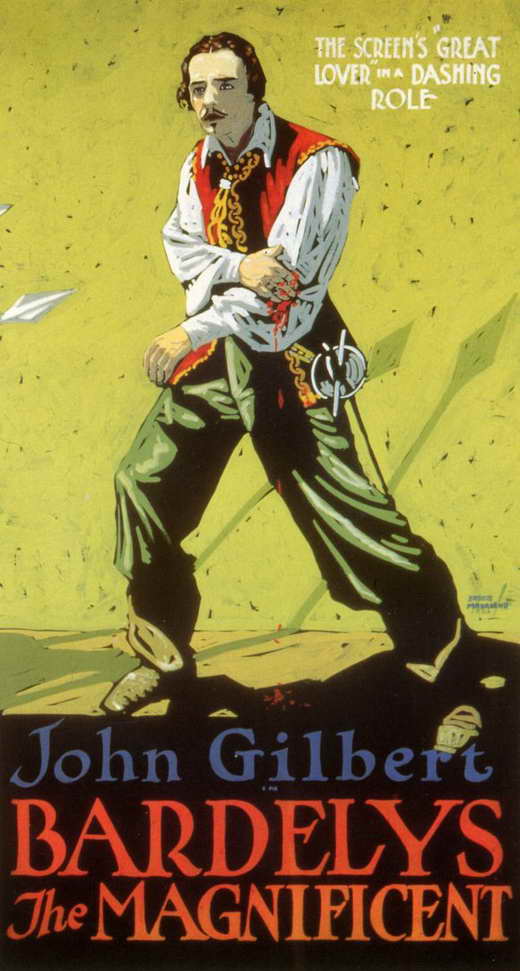

Production and style
Produced and distributed by Metro-Goldwyn-Mayer, the picture showcases the lavish production values associated with major silent-era studios. King Vidor, an influential director of the period, combined atmospheric staging, location-like sets and careful lighting to create a sense of period authenticity. As a silent film, it depends on expressive acting, costume design and edited sequences to sustain its dramatic pacing rather than spoken dialogue.
Cast and performances
The film stars John Gilbert and Eleanor Boardman in the leading roles, supported by a company that included Lionel Belmore, Emily Fitzroy, Edward Connelly and Theodore von Eltz. Notably, a young John Wayne appears in a very small, uncredited background role early in his career; this fact is often cited when discussing Wayne's beginnings in Hollywood. Performances lean toward the expressive and romantic style common to silent cinema, with the principal stars carrying both dramatic and romantic weight.
Adaptation and source
The narrative is adapted from Rafael Sabatini's novel, which combines adventure, romance and historical detail. Sabatini was known for swashbuckling tales and romantic adventure novels; film adaptations of his work sought to capitalize on that blend of action and sentiment. The screenplay condenses and streamlines the novel's episodes to fit the film medium and the era's expectations for pacing and visual storytelling.
Preservation and legacy
For many years the film was less accessible than some contemporaries, and for a time it was regarded among the silent-era titles that were incomplete or at risk. Over the decades copies and fragments have surfaced in archives and private collections, allowing modern audiences and film historians to reassess its place in King Vidor's work and in the careers of its stars. Today the film is discussed in histories of 1920s studio production, silent-era star vehicles and early screen adaptations of popular adventure fiction.
Why the film matters
Bardelys the Magnificent is of interest as an example of mid-1920s Hollywood craftsmanship: a star-led costume drama produced by a major studio, directed by an important filmmaker of the silent era, and adapted from a well-known novelist of adventure fiction. It illustrates how silent films balanced spectacle and narrative and how later rediscoveries can change a title's reputation among scholars and classic film enthusiasts.
- Director: King Vidor
- Based on: Rafael Sabatini (1906 novel)
- Main stars: John Gilbert, Eleanor Boardman
- Distributor: Metro-Goldwyn-Mayer
- Notable cameo: John Wayne (uncredited)
Questions and answers
Q: When was Bardelys the Magnificent released?
A: Bardelys the Magnificent was released in 1926.
Q: Who directed Bardelys the Magnificent?
A: Bardelys the Magnificent was directed by King Vidor.
Q: What is the basis of the movie?
A: Bardelys the Magnificent is based on the 1906 novel of the same name by Rafael Sabatini.
Q: Who are the main actors in the movie?
A: The main actors in Bardelys the Magnificent are John Gilbert, Eleanor Boardman, Lionel Belmore, Arthur Lubin, Emily Fitzroy, John Wayne, Edward Connelly, and Theodore von Eltz.
Q: Who distributed Bardelys the Magnificent?
A: Bardelys the Magnificent was distributed by Metro-Goldwyn-Mayer.
Q: What genre does Bardelys the Magnificent belong to?
A: Bardelys the Magnificent belongs to the romantic drama genre.
Q: Is Rafael Sabatini the author of the 1906 novel Bardelys the Magnificent?
A: Yes, Rafael Sabatini is the author of the 1906 novel Bardelys the Magnificent.
Related articles
Author
AlegsaOnline.com Bardelys the Magnificent (1926 film) Leandro Alegsa
URL: https://en.alegsaonline.com/art/8946