
Sailing (sport)
Competitive sailing: racing from small dinghies to large yachts around marked courses. Includes one-design and handicap formats, rules, tactics, boat types, history, and notable events and distinctions.
Overview
Sailing as a sport is the organized competition of boats propelled primarily by the wind. Competitors follow a prescribed course laid out on open water or in sheltered venues and attempt to complete it in the fastest time. Courses are defined by fixed or floating marks such as buoys, which competitors must round in a specified order; these course markers are often referred to simply as buoys. Races can take place on lakes, coastal waters, or offshore and range from short sprints to long-distance events.
Image gallery
8 Images

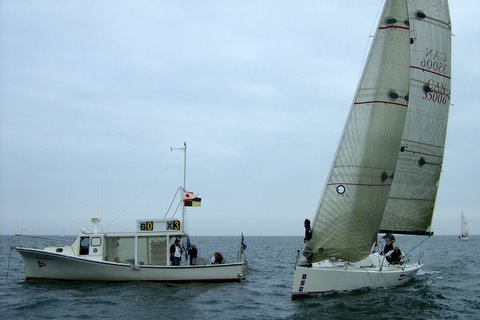



Boats, classes and equipment
Racing boats vary widely in size and design. At one end are small one- or two-person dinghies that emphasize agility and sailor skill; these are commonly called dinghies. At the other end are large keelboats and yachts used for match racing, fleet racing, and offshore competitions; such vessels are often described as yachts. Many classes exist to group boats with similar characteristics so that equipment differences do not dominate results. Typical gear includes sails, rigging, centerboards or keels, and safety equipment appropriate to the event and conditions.
Race formats, rules and scoring
Two principal formats are common: one-design and handicap. In one-design racing all boats are of the same design so that outcomes depend largely on tactics and crew work. Handicap racing mixes different types or sizes of boats and applies a rating system to adjust elapsed times so that diverse designs can compete fairly; these systems are referred to generically as handicap methods. Races are governed by a code of rules covering starts, mark roundings, right-of-way, penalties, and protests; internationally, many events follow rules set by leading sport sailing authorities.
Common race types and crew roles
- Fleet racing: many boats start together and the first to finish wins.
- Match racing: head-to-head contests between two boats, emphasizing tactics.
- Team racing: crews of multiple boats compete cooperatively against another team.
- Offshore and ocean racing: long-distance events requiring navigation and seafaring skill.
Typical crew roles include helmsman (steers), trimmers (control sails), tactician (plans strategy), and bowman (handles sails at the front). On larger yachts additional roles cover navigation, watchkeeping, and maintenance.
History, development and importance
Competitive sailing has roots in recreational and commercial seafaring traditions; organized yacht clubs and regattas date back centuries. Over time advances in materials, sail design and measurement rules have diversified classes and increased speeds. Sailing has been part of major international multisport events and has a well-developed amateur and professional circuit, contributing to maritime skills, boat design innovation, and coastal economies.
Notable distinctions and facts
Sailing rewards tactical decision-making, teamwork and seamanship as much as physical fitness. Weather and sea state play a central role, making each race unique. While equipment parity is emphasized in one-design fleets, rating systems attempt to maintain fairness in mixed fleets. Learning to race offers practical navigation, meteorology and mechanical skills valuable both in sport and broader boating activities.
Questions and answers
Q: What is the sport of sailing?
A: The sport of sailing involves racing other boats around a track or course marked with floating buoys or other fixed marks.
Q: What types of boats can be used in sailing?
A: Boats used in sailing can range from small dinghies to large yachts.
Q: What is one-design racing?
A: One-design racing is where small boats of the same type race against each other.
Q: How do larger boats typically race in sailing?
A: Larger boats in sailing will often be of different sizes and race with a handicap system.
Q: What is a handicap system in sailing?
A: In sailing, a handicap system is used to equalize the abilities of different boats based on their size and other factors. This allows for fair competition between boats of differing size and ability.
Q: How are racecourses marked in sailing?
A: Racecourses in sailing are marked with floating buoys or other fixed marks.
Q: What is the ultimate goal in sailing?
A: The ultimate goal in sailing is to be the first boat to cross the finish line, and therefore win the race.
Related articles
Author
AlegsaOnline.com Sailing (sport) Leandro Alegsa
URL: https://en.alegsaonline.com/art/85304
Sources
- stillmed.olympic.org : "SAILING: History of Sailing at the Olympic Games"
- rorc.org : Royal Ocean Racing Club
- rolexsydneyhobart.com : Rolex Sydney Hobart Yacht Race, 630 nm
- thegovernorscuponline.com : The Governor's Cup, Cape Town to St. Helena Island, 1690 nautical miles (nm)
- southatlanticrace.co.za : Heineken Cape to Bahia Race (South Atlantic Race), 3500 nm
- afloat.ie : "First Two Campaigns Announced For 2021 As The Ocean Race Enters New Era"
- theguardian.com : "British man, 60, dies while taking part in round-the-world yacht race"
- afloat.ie : "Water Wags Still Learning New Tricks After 131 years"
- sailing.org : "Racing Rules of Sailing"