
Baguio — Philippine mountain city and Summer Capital
Baguio is a city in northern Luzon, Philippines, known for its cool mountain climate, pine forests, cultural festivals and role as the Cordillera region's economic and educational center.

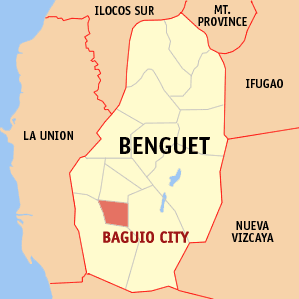
Baguio is a highland city in northern Luzon in the Philippines, often called the Summer Capital of the country because its elevation produces a noticeably cooler climate than the lowlands. The city sits within the territory of Benguet province but is administered as a separate chartered city. Baguio is also commonly known as the "City of Pines" for its pine stands and mountain flora. For local names and language context see Tagalog and other local names.
Image gallery
10 Images




Geography and climate
Baguio lies on a plateau more than a thousand meters above sea level, surrounded by ridges and bowl-like valleys. This altitude moderates temperatures and supports plant species—pine trees, orchids and temperate vegetables—that are unusual elsewhere in the Philippines. The city's setting gives it scenic viewpoints and pockets of evergreen vegetation, and it functions as a cooler retreat from the tropical lowlands. For regional context see Luzon and northern highlands.
History and development
The modern city developed during the American colonial period in the early 20th century when planners and administrators selected the site for a hill station and administrative center. American urban planner Daniel Burnham contributed to its early design concept, and the city later evolved into a chartered municipality with a distinct administrative status. Historically Baguio also served as the capital of Benguet province prior to becoming an independent city unit.
Economy, culture and tourism
Baguio is an economic and educational hub for the Cordillera region, with schools, trade, government services and tourism as major activities. Visitors are drawn by parks, markets, historic sites and seasonal events such as flower festivals that celebrate the city's horticultural traditions. The local economy includes hospitality, small-scale manufacturing, food services and retail geared to both residents and visitors.
Notable features and civic role
Key urban features include public parks, promenades, market areas and municipal institutions. The city plays a central role in the Cordillera Administrative Region as a service center for neighboring provinces, offering higher education, healthcare and administrative functions. Its cultural life blends indigenous Cordilleran traditions, lowland Filipino influences and the legacy of American-era planning. For information on administrative organization and regional ties see Cordillera region and Philippine administrative divisions.
Distinctive facts
- Baguio's cooler climate makes it a popular domestic destination during the hot season.
- It is widely associated with pine trees and mountain vistas within the Philippine archipelago.
- The city serves as a center for education, culture and commerce in the northern highlands.
Population figures vary by census; the city had several hundred thousand residents in the early 21st century and continues to function as a compact but densely settled urban center in a mountainous setting. Its combination of climate, history and role in the Cordilleras makes Baguio distinct among Philippine cities.
Related articles
Author
AlegsaOnline.com Baguio — Philippine mountain city and Summer Capital Leandro Alegsa
URL: https://en.alegsaonline.com/art/8308