
Richard Thompson (cartoonist)
American illustrator and cartoonist Richard Thompson was known for the comic strip Cul de Sac, the illustrated poem 'Make the Pie Higher', and his fluid, expressive drawing style.
Overview
Richard Church Thompson (October 8, 1957 – July 27, 2016) was an American illustrator and cartoonist celebrated for his inventive line work and keen comic sensibility. He gained widespread recognition for the suburban childhood comic strip Cul de Sac and for his illustrated rendering of the piece commonly called "Make the Pie Higher." His peers honored him with the Reuben Award for Outstanding Cartoonist of the Year in 2010.
Image gallery
2 Images
Style and themes
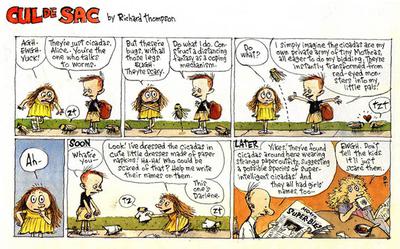
Thompson's drawing style combined free, energetic ink lines with careful attention to facial expression and motion. His work is often noted for its ability to convey speed, mood and personality with seemingly effortless strokes. In storytelling he favored small, domestic scenes and the viewpoint of children, drawing humor from everyday misunderstandings and the inner logic of youthful characters.
Major works and characters
The best known of Thompson's creations is Cul de Sac, a strip that centers on the daily life of a young child and her neighborhood. He produced both short gag strips and longer, character-driven sequences that showed emotional as well as comic range. Thompson also produced editorial cartoons, standalone illustrations and book collections of his comics. Notable titles and pieces include:
- Cul de Sac — suburban comic strip featuring child-centered vignettes
- Illustrations for the poem often referred to as "Make the Pie Higher"
- A variety of editorial cartoons and published collections showcasing his line art
Career, recognition and influence
Thompson worked across newspapers, magazines and syndication, earning admiration from fellow cartoonists and critics for both technique and humor. His 2010 Reuben Award acknowledged his status among contemporary cartoonists. Beyond awards, his influence is visible in the work of artists who cite his economy of line and timing as inspiration. For more on his publications and archives, see related resources.
Illness, final years and legacy
In later years Thompson battled Parkinson's disease, a progressive neurological condition that affected his ability to draw. He died on July 27, 2016, from complications related to that illness at age 58. Coverage of his passing and retrospectives on his work appeared in major outlets; one can find contemporary reports and remembrances via news coverage. Thompson's strips and illustrations remain studied for their craft, warmth and technical mastery, and collections of his work continue to be read by new audiences.
Notable facts: Thompson balanced sharp humor with empathy, and his approach to characters—particularly children—helped broaden what daily comic strips could address emotionally and artistically.
Related articles
Author
AlegsaOnline.com Richard Thompson (cartoonist) Leandro Alegsa
URL: https://en.alegsaonline.com/art/82729
Sources
- washingtonpost.com : "Richard Thompson, acclaimed 'Cul de Sac' creator and Post contributor, dies at 58"