
Resultant force (net force): definition, calculation and examples
A resultant (or net) force is the single force that represents the vector sum of all forces on a body. Explains calculation in one and two dimensions, examples, applications and key distinctions.
Overview
The resultant force, often called the net force, is a single force that produces the same effect on an object as all the individual forces acting on it combined. It is obtained by adding vectors that represent each force. The magnitude of force is measured in the unit called the Newton (N). When the resultant is zero the forces balance and the object's motion does not change; a non‑zero resultant causes acceleration according to Newton's second law.
Image gallery
1 Image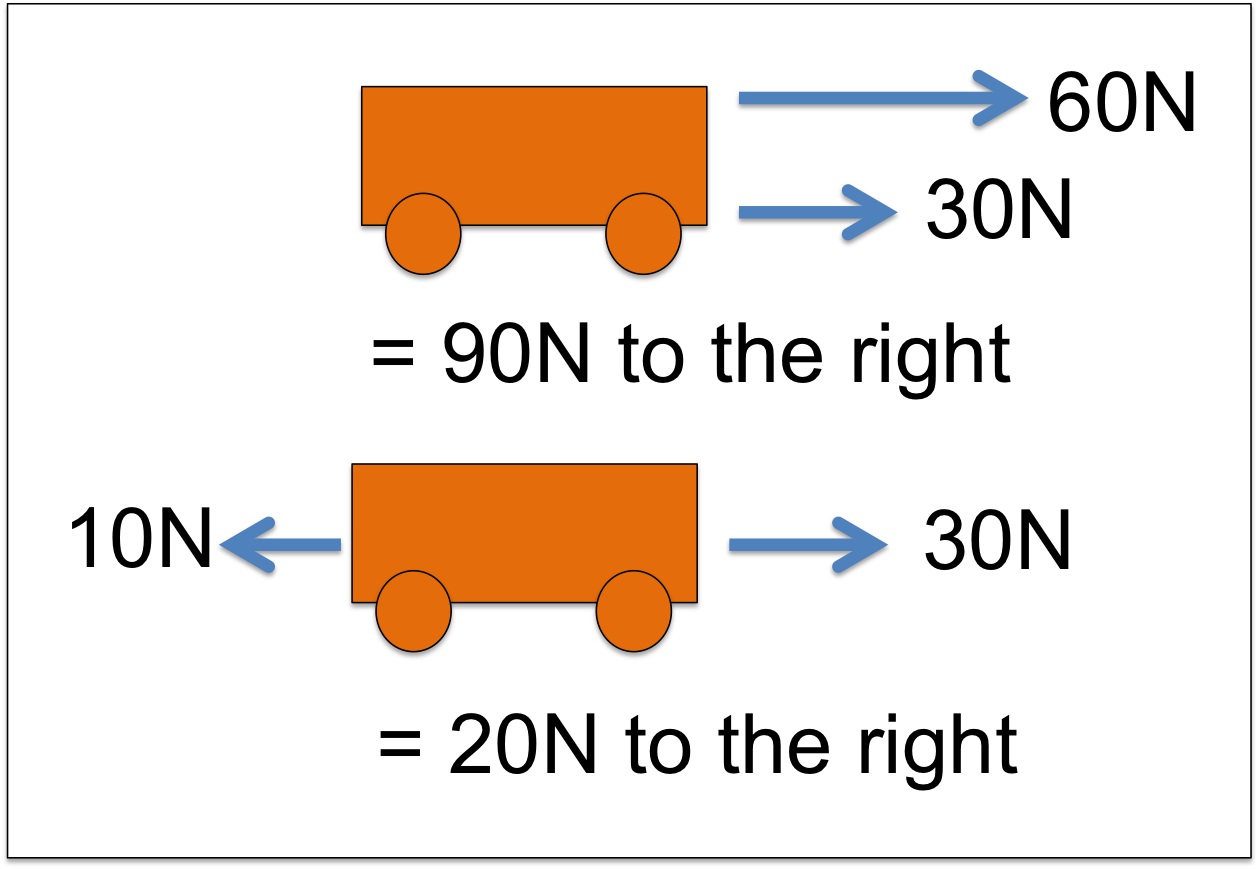
How the resultant is determined
In one dimension (a straight line) forces are added algebraically, taking account of direction. For example, two forces of 30 N and 60 N acting to the right give a resultant of 90 N to the right; if 40 N acts left and 30 N right the net result is 10 N to the left. In two or three dimensions forces are vectors and must be combined by vector addition.
Methods of calculation
- Graphical methods: use the triangle or parallelogram rule to place vectors tip to tail; the single vector from the free tail to the free tip is the resultant.
- Analytical methods: resolve each force into orthogonal components (for example, x and y). Sum all x components and all y components separately, then compute the resultant magnitude from the component sums and its direction by the appropriate angle function.
An elementary two‑dimensional example: forces of 3 N east and 4 N north combine to a 5 N resultant directed northeast (a 3–4–5 right triangle).
Applications and examples
Understanding the resultant is central in mechanics. Engineers use net force to design structures and machines, physicists use it to predict motion, and sports scientists consider it when analyzing impacts and propulsion. A free‑body diagram showing all applied forces helps identify the resultant acting on the center of mass or at a particular point of interest.
Important distinctions and notes
"Resultant force" refers to the combined translational effect of forces. It is distinct from moments (torques) which cause rotation; two forces can have the same resultant but different turning effects depending on their lines of action. In statics the special case of zero resultant (and zero net moment) defines equilibrium. In dynamics, the net force determines the mass times acceleration of the body (F_net = m·a).
When reporting or calculating resultants, always include both magnitude and direction and, where relevant, the point or line of application because the same resultant can produce different motions if applied at different locations on the object.
Related articles
Author
AlegsaOnline.com Resultant force (net force): definition, calculation and examples Leandro Alegsa
URL: https://en.alegsaonline.com/art/82327
Sources
- eschooltoday.com : "Resultant forces"