
Republic County, Kansas
Republic County is a sparsely populated county in northern Kansas on the Nebraska border, with Belleville as its county seat and a landscape dominated by agriculture and small towns.
Overview
Republic County is a county in the U.S. state of Kansas. Located along the southern edge of the Great Plains, the county lies just south of the state line with Nebraska. At the time of the 2010 census, the population was about 4,980 people. The county seat and largest city is Belleville, which serves as the center for local government and services (county seat).
Image gallery
4 Images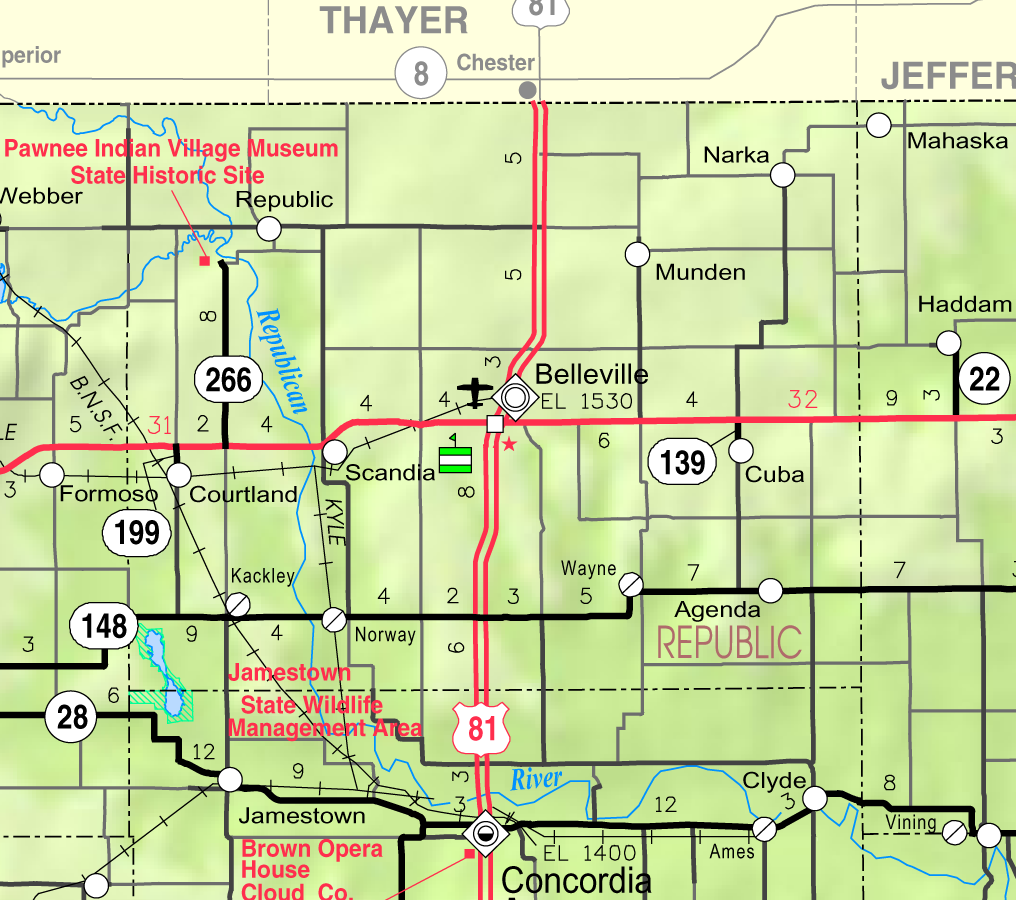


Geography and environment
Republic County consists of gently rolling prairie typical of north-central Kansas. Soils and climate favor grain farming and livestock grazing. The landscape is a mosaic of cultivated fields, pastures and small patches of native prairie. Streams and small reservoirs provide local water resources and recreational opportunities.
History and development
The region was inhabited originally by Native American peoples and was opened to European-American settlement in the 19th century. Towns grew up around agricultural trade, rail stops and county government. Over time the local economy and settlement patterns have reflected larger trends in rural America, including mechanization, consolidation of farms and population shifts toward larger urban areas.
Economy and community life
Agriculture remains the primary economic activity, supplemented by small businesses, light manufacturing and public services based in towns like Belleville. Schools, churches and local events form the social fabric of the county. Many residents travel to regional centers for specialized services, higher education and medical care.
Government, transportation and places
- Local government is centered in the county courthouse in Belleville.
- Transportation consists mainly of state and county highways; historic rail lines shaped early growth.
- The county contains several small towns and rural townships that provide community hubs for surrounding farmland.
For basic reference and civic information, consult county offices and regional resources. Maps and historical summaries are available from local repositories and state archives; many visitors come for rural landscapes, community festivals and local museums that preserve the county’s history.
Questions and answers
Q: What is Republic County known for?
A: Republic County is a county in the state of Kansas.
Q: Which state is Republic County located in?
A: Republic County is located in the state of Kansas.
Q: Where is Republic County in relation to the Nebraska border?
A: Republic County is located south from the Nebraska border.
Q: How many people lived in Republic County according to the 2010 census?
A: According to the 2010 census, 4,980 people lived in Republic County.
Q: What is the county seat of Republic County?
A: The county seat of Republic County is Belleville.
Q: Which city in Republic County is the biggest?
A: Belleville is the biggest city in Republic County.
Q: What is the standard abbreviation for Republic County?
A: The standard abbreviation for Republic County is RP.
Related articles
Author
AlegsaOnline.com Republic County, Kansas Leandro Alegsa
URL: https://en.alegsaonline.com/art/82224
Sources
- quickfacts.census.gov : "State & County QuickFacts"
- naco.org : "Find a County"
- skyways.lib.ks.us : A history of Republic County, Kansas : embracing a full and complete account of all the leading events in its history, from its first settlement down to June 1, '01
- kshs.org : kshs.org/p/bohemians-czechs-and-moravians-to-kansas-a-bibliography/13535
- census.gov : "Census 2000 U.S. Gazetteer Files: Counties"
- census.gov : "US Gazetteer files: 2010, 2000, and 1990"
- census.gov : "Population and Housing Unit Estimates"
- census.gov : "U.S. Decennial Census"
- mapserver.lib.virginia.edu : "Historical Census Browser"
- census.gov : "Population of Counties by Decennial Census: 1900 to 1990"
- census.gov : "Census 2000 PHC-T-4. Ranking Tables for Counties: 1990 and 2000"
- uselectionatlas.org : uselectionatlas.org/RESULTS/