
Acute angle
An acute angle is an angle smaller than a right angle (0°–90°). Covers definition, properties, measurement, examples such as acute triangles, historical notes, and distinctions from other angle types.
Overview
An acute angle is any angle whose measure is greater than 0 degrees and less than 90 degrees (0 < θ < 90°), equivalently between 0 and π/2 radians. The adjective "acute" is derived from the Latin word acutus, meaning "sharp" or "pointed," reflecting the visually sharp appearance of small angles. Formally, an acute angle is strictly smaller than a right angle and strictly larger than a zero angle.
Image gallery
2 Images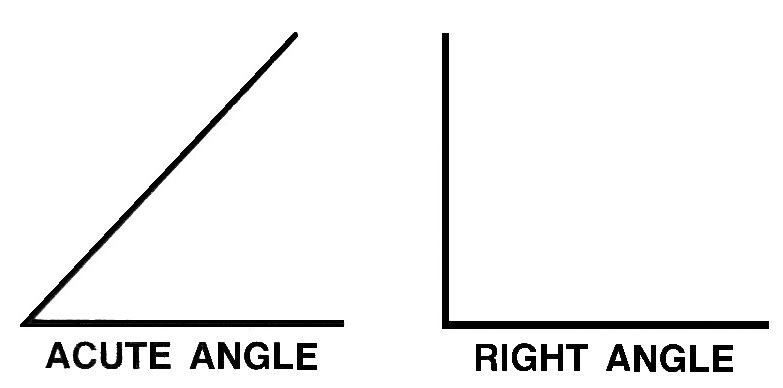

Properties and simple facts
Acute angles appear frequently in basic geometry and trigonometry. In standard position on the Cartesian plane (vertex at the origin and one side along the positive x-axis), an acute angle places its terminal ray in the first quadrant, where both sine and cosine values are positive. Two acute angles can be complementary if their measures add to exactly 90°; complementarity is a common relation used in solving geometric problems.
How to recognize and measure
Visual recognition: an acute angle looks smaller than a quarter-turn of a circle. Measurement is usually done with a protractor or by calculating angles from known side lengths using trigonometric ratios or vector dot products. Basic steps to measure an angle with a protractor:
- Place the protractor's center at the vertex of the angle.
- Align the zero line with one side of the angle.
- Read the scale where the other side crosses the protractor; if the result is less than 90°, the angle is acute.
Examples and importance
Common examples include the 60° angles in an equilateral triangle and many roof pitches, truss designs, and machine parts where small angles improve fit or strength. In triangle classification, an "acute triangle" has all three interior angles acute. Acute angles are central to trigonometric definitions and to construction tasks where precise, small angles are required.
History, terminology and related angle types
The basic distinction between acute, right, obtuse and reflex angles dates to ancient geometric traditions where descriptive terms helped classify shapes. Contrast with related types: a obtuse angle measures between 90° and 180°, a right angle is exactly 90°, and a reflex angle exceeds 180° but is less than 360°. Understanding these categories aids in proofs, construction and in applying trigonometric identities.
Notable uses and further reading
Acute angles are widely used in architecture, carpentry, mechanical design and navigation. They also appear in theoretical contexts, for instance when analyzing vector directions, optimizing fits, or studying acute-angled triangles in Euclidean geometry. For a concise formal definition and related terms see general angle references and introductory geometry texts (definition and overview).
Related articles
Author
AlegsaOnline.com Acute angle Leandro Alegsa
URL: https://en.alegsaonline.com/art/820