
Adam Ries (Adam Riese) — German arithmetician and author
Sixteenth-century German mathematician known for practical arithmetic books in the vernacular, promotion of Hindu–Arabic numerals, and lasting influence on commercial calculation and education.
Overview
Adam Ries (also spelled Riese) was a German mathematician and teacher active in the early 16th century. Born around 1492–1493 in the Staffelstein region, he spent much of his adult life working where mining and trade were flourishing and died in 1559. Ries is best known for producing accessible arithmetic manuals that taught practical computation to merchants, artisans and clerks rather than presenting abstract theory. For a concise biographical overview see a short biography.
Image gallery
7 Images




Works and methods
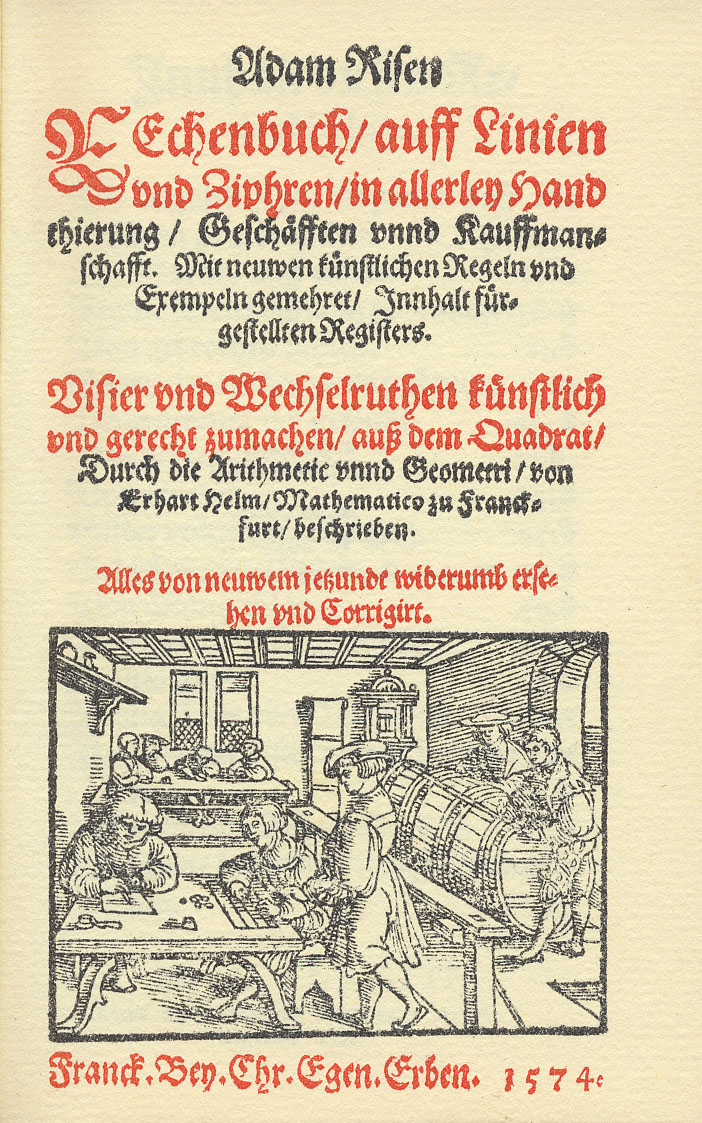
Ries wrote several popular arithmetic treatises in the German vernacular rather than in Latin, which made them useful to a wide audience of tradespeople. His books explain calculation on a "calculating board" (a tabletop device of counters and lines) and how to perform operations using the more efficient Hindu–Arabic place-value numerals in place of Roman numerals. The calculating board he described is functionally similar to an abacus, but adapted to the commercial methods of his time.
Practical content and examples
Ries's manuals emphasize the everyday arithmetic problems of commerce: addition and subtraction of multi-digit numbers, long multiplication and division, rule of three (proportions), simple algebraic thinking for solving unknown quantities, handling fractions, and computations for interest, exchange and measures. His examples are concrete—prices, weights, and mixtures—so readers could transfer methods directly to shopkeeping and bookkeeping.
Historical context and development
Composed in the first half of the 16th century, Ries's books reflect a period when European trade required reliable, repeatable calculation and when the Hindu–Arabic numeral system was supplanting older numeric formats. By writing in German he helped standardize arithmetic practice in German-speaking regions and made instruction widely accessible. Local institutions and museums in his native area preserve his memory and editions of his work—several sites in Bad Staffelstein and in Bavaria maintain exhibits and annual commemorations.
Legacy and notable facts
- Ries popularized calculation methods for everyday use rather than academic research, contributing to practical numeracy in commerce and crafts.
- His choice to write in the vernacular set a precedent for technical writing aimed at practitioners rather than scholars.
- In German popular culture the phrase "nach Adam Riese" (according to Adam Ries) remains an idiom invoking correct arithmetic.
For further reading on his life, his surviving editions and modern interpretations of his methods, consult digitized collections and museum pages linked above and specialist studies that place his work in the transition from medieval reckoning to early modern commercial arithmetic.
Questions and answers
Q: Who was Adam Ries?
A: Adam Ries was a mathematician from Bad Staffelstein in Bavaria who lived in the 16th century.
Q: When was Adam Ries born and when did he die?
A: Adam Ries was born in 1492 or 1493, and he died in 1559.
Q: What did Adam Ries become known for?
A: Adam Ries became known for a work on how to calculate.
Q: What was Adam Ries' first work about?
A: Adam Ries' first work was about a "calculating board", which was widely used at the time. It worked rather like an abacus.
Q: What did Adam Ries show about Roman numerals?
A: Adam Ries showed that Roman numerals were impractical for calculation.
Q: In what language did Adam Ries write his work?
A: Adam Ries wrote in German, and not in Latin, as other mathematicians of his time.
Q: Why should we know about Adam Ries?
A: We should know about Adam Ries because he was a pioneer of calculation methods and made significant contributions to the field of mathematics.
Related articles
Author
AlegsaOnline.com Adam Ries (Adam Riese) — German arithmetician and author Leandro Alegsa
URL: https://en.alegsaonline.com/art/861