
Background radiation: sources, measurement, variation, and health context
Background radiation is the continuous low-level ionizing radiation from natural and artificial sources. This article explains its origins, measurement, variation by location, health considerations and mitigation.
Overview
Background radiation is the omnipresent ionizing radiation that people receive simply by living on Earth. It includes radiation from natural radioactive materials in the ground and in our bodies, from cosmic rays arriving from space, and from low-level artificial sources such as medical imaging. For a general introduction see background radiation.
Image gallery
10 Images






Primary sources and characteristics
Major natural contributors are:
- Radon: a radioactive gas produced by decay of uranium in soils and rocks; it accumulates in buildings and is a leading component of natural exposure. More detail is available at radon information.
- Terrestrial radionuclides: long-lived isotopes such as uranium, thorium and potassium-40 present in soil, rock and building materials. See soil and rock sources.
- Internal radionuclides: isotopes taken into the body through food, water or air (for example potassium-40 and carbon-14). For internal pathways consult internal contamination.
- Cosmic radiation: high-energy particles from space that produce secondary radiation in the atmosphere; exposure increases with altitude and decreases slightly with latitude. Learn more at cosmic radiation.
Measurement, units and instruments
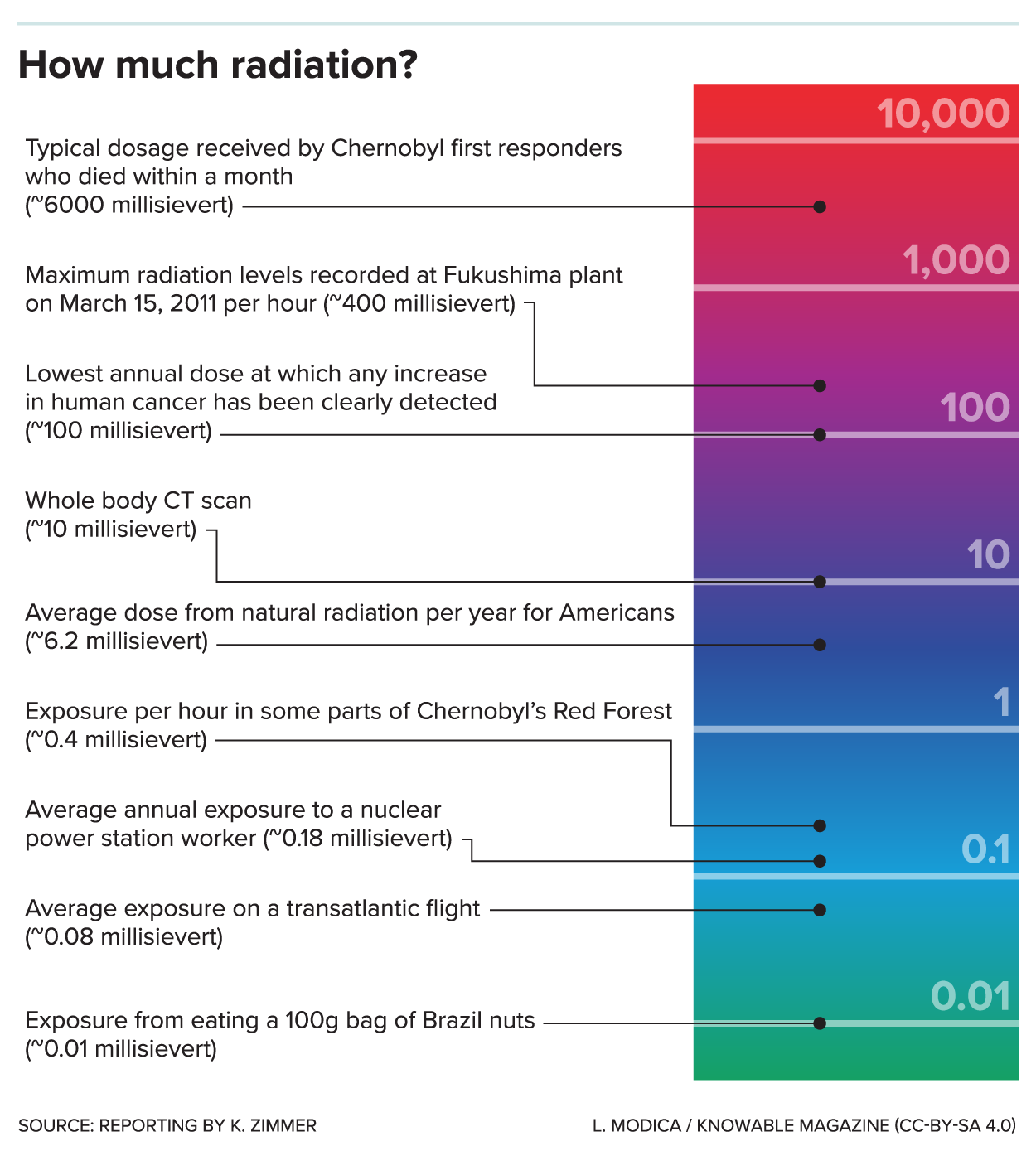
Radiation exposure is described in several ways. Activity (becquerel) counts decays per second; absorbed dose (gray) measures energy deposited per kilogram; and effective dose (sievert) weights absorbed dose by biological effect and tissue sensitivity. Typical worldwide average natural effective dose is about 2.4 mSv per year, with substantial local variation. Instruments used for detection and monitoring include Geiger–Müller tubes, scintillation counters and personal dosimeters; introductory resources are collected at radiation measurement and detector types.
Variation, notable examples and history
Natural background varies by geology, altitude, building style and lifestyle. Some countries and regions record average natural background doses well below 2 mSv/year, while others report higher averages; for instance, national averages in Europe range from under 2 mSv annually in some areas to more than 7 mSv for particular groups in other areas. Historical study of radioactivity began in the late 19th and early 20th centuries with discoveries by Becquerel and the Curies; mapping and measurement improved through the 20th century as instrumentation matured. For background on radionuclide origins and decay chains see radionuclide families and decay products.
Health implications and practical importance
At the low doses typical of natural background, individual risk changes are small but measurable in large populations; radon exposure is a well-established risk factor for lung cancer, particularly among smokers. Medical exposures (diagnostic X-rays, CT scans) are the largest controllable artificial contribution to an individual's dose. Radiation protection follows principles of justification and optimization (ALARA — as low as reasonably achievable). For regulatory and health guidance consult summaries at health guidance and monitoring programs at public resources.
Mitigation, monitoring and practical advice
Homes can be tested for radon and, if necessary, mitigated by improving ventilation or installing depressurization systems. Workers in aviation, radiology or certain industrial settings may use personal dosimeters to track accumulated dose. Public health agencies recommend targeted action where measured concentrations or doses exceed reference levels. For practical testing and mitigation methods see testing methods and mitigation strategies.
Key distinctions: background radiation differs from short-term contamination or accidental releases in that it is continuous, low-level and largely unavoidable; yet it is quantitatively assessed and managed through monitoring, building practices and medical decision-making. For further reading and technical references use the linked resources throughout this article: measurement, radon, isotopes, and cosmic sources.
Related articles
Author
AlegsaOnline.com Background radiation: sources, measurement, variation, and health context Leandro Alegsa
URL: https://en.alegsaonline.com/art/8111
Sources
- world-nuclear.org : "Natural radiation in western Europe"