
Quantum entanglement: overview, history, and practical significance
Quantum entanglement is a nonclassical correlation between quantum systems that ties their properties even when separated; it underpins quantum technologies and challenged classical physics.
Overview
Quantum entanglement describes a relationship between two or more quantum systems in which their joint state cannot be written as a simple combination of independent states for each subsystem. In an entangled state, measurements performed on one part produce outcomes that are correlated with results on the other parts in ways that cannot be explained by shared classical information alone. These correlations persist even when the systems are spatially separated, a feature that made entanglement a subject of intense conceptual debate.
Image gallery
2 Images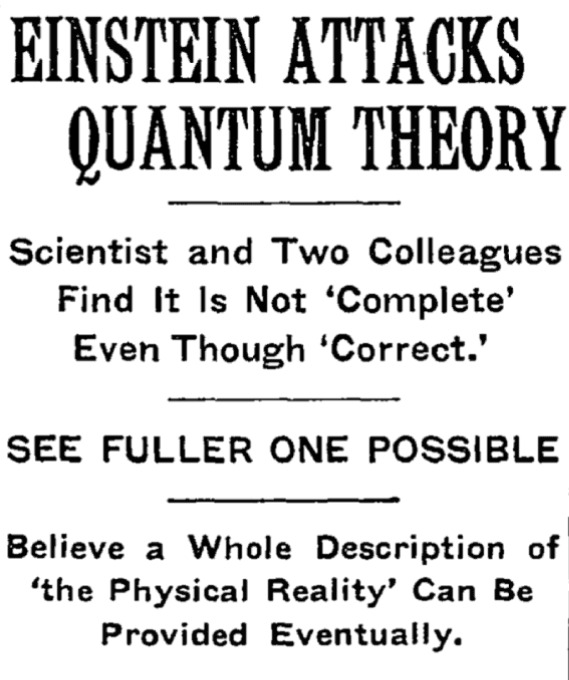

Key characteristics
An entangled pair exhibits these common features: the global state is not factorable into local states; local measurement outcomes can appear random but show strong statistical correlations; and the formal description of one subsystem may change instantaneously when the other is measured, though this does not enable faster-than-light communication. Entanglement is quantified in various ways (for pure states by measures such as entropy of entanglement), and extends to multipartite systems with richer structure.
Historical development
Discussion of entanglement dates to the 1935 paper by Einstein, Podolsky, and Rosen, which questioned whether quantum mechanics provides a complete description of physical reality. Erwin Schrödinger coined the term "entanglement" and emphasized its oddity. In 1964 John Bell derived inequalities that distinguish quantum predictions from local realistic theories; subsequent laboratory tests in the 1970s–1980s and later closed various experimental loopholes, establishing that quantum mechanics violates Bell inequalities under appropriate conditions.
Uses and examples
Entanglement is a resource in emerging technologies. Examples include:
- Quantum computing: entangled qubits enable algorithms and error-correction schemes.
- Quantum cryptography: protocols such as device-independent key distribution rely on entanglement and Bell tests.
- Quantum teleportation: transfer of quantum states uses entangled pairs plus classical communication.
- Metrology: entangled states can improve measurement precision beyond classical limits.
Distinctions and notable facts
Entanglement differs from ordinary correlation because it involves the nonseparability of the quantum state. Despite the appearance of instantaneous change in state description, entanglement does not permit controllable superluminal signaling. Experimental control of entanglement spans systems from photons and trapped ions to superconducting circuits. For an introductory technical treatment and further resources, see Further reading.
Related articles
Author
AlegsaOnline.com Quantum entanglement: overview, history, and practical significance Leandro Alegsa
URL: https://en.alegsaonline.com/art/80383