
Provinces of the Dominican Republic: organization, roles, and local government
Overview of the Dominican Republic's 31 provinces, the National District, their administrative roles, municipal subdivisions, political representation, history, and notable features.
Overview
The Dominican Republic is divided into thirty-one provinces and one special district. In Spanish these are called provincias. Provinces serve as the country's primary subnational units for administration, elections, and statistical reporting. Each province has a capital city and a provincial identity that reflects historical, geographic, or cultural features.
Image gallery
4 Images

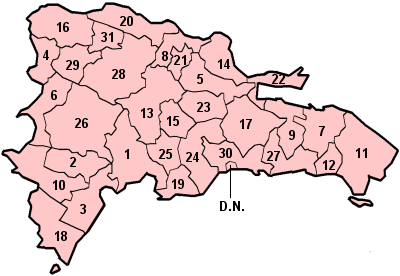


Administrative structure
Every province (except the separate National District) has a Civil Governor (Gobernador Civil) appointed by the President to represent the central government at the provincial level. The governor's role is largely representative rather than executive: implementation of policy and public services is primarily the responsibility of national ministries and locally elected municipal authorities. Provincially, the population elects one Senator and at least two Representatives (Diputados) to the National Congress, providing legislative representation based on the province as an electoral unit.
Municipal organization
Provinces are subdivided into municipalities and municipal districts. There are 154 municipalities and 202 municipal districts across the country. Municipalities are governed by municipal councils and mayors chosen by popular vote, and they carry responsibility for many local services, urban planning, and community needs. Some larger municipalities are further divided into municipal districts; these subdivisions also have their own councils and mayors to manage neighborhood-level affairs. The term municipio denotes a municipality in Spanish.
The National District
The National District (Distrito Nacional) functions like a province for many purposes but differs in several legal and administrative respects. It contains a single municipality, Santo Domingo de Guzmán, which is the country's principal city and the national capital. Unlike provinces, the National District does not have a Civil Governor appointed by the President; its municipal government has augmented responsibilities because of the district's national importance and dense urban population.
History and purpose
The present provincial division evolved over two centuries from colonial-era territories, independence-era reorganizations, and later legislative reforms that created new provinces or modified boundaries to respond to population growth and administrative needs. Today the provincial map is used for organizing public administration, allocating seats in the legislature, planning infrastructure, and collecting demographic and economic statistics.
Notable facts and distinctions
- Provinces vary widely in area and population: some are predominantly urban and densely populated, while others are largely rural with agricultural economies.
- The appointment of a Civil Governor is mostly symbolic and intended to maintain a direct link between each province and the national executive.
- Electoral representation is tied to provinces: each sends one Senator to the national legislature, ensuring provincial voices in lawmaking.
- For comparative lists, maps, and further administrative details see provincial references and statistical publications often cited by government or academic sources (provinces).
These layers of government—national, provincial (or National District), municipal, and municipal district—create a structure designed to balance centralized policymaking with locally elected authorities responsible for day-to-day public services and community development.
For detailed lists of provinces and their capitals, population counts from recent censuses, and historical boundary changes, consult official statistical releases and legal texts that establish provincial boundaries and governance rules. Additional resources and maps are available from governmental and scholarly sources identifying each province by name and capital.
Representative roles, legislative context, and municipal governance are central to understanding how provincial divisions affect everyday life and politics in the Dominican Republic.
Questions and answers
Q: How many provinces are in the Dominican Republic?
A: There are thirty-one (31) provinces in the Dominican Republic.
Q: What is the role of a Civil Governor in the Dominican Republic?
A: The only function of a Civil Governor in the Dominican Republic is to represent the President of the Republic in the province.
Q: Who elects a Senator and Representatives in a province in the Dominican Republic?
A: The people who live in the province elect one Senator (Senador) and at least two (2) Representatives (Diputados) for the National Congress.
Q: What is the National District in the Dominican Republic?
A: The National District is similar to a province but without a Civil Governor and with only one municipality, Santo Domingo de Guzmán, the national capital.
Q: How are municipalities governed in the Dominican Republic?
A: Municipalities in the Dominican Republic are governed by municipal councils and mayors elected by popular vote.
Q: What are municipal districts in the Dominican Republic?
A: Municipal districts in the Dominican Republic are subdivisions of some municipalities ruled by a municipal council and a mayor.
Q: How many municipalities and municipal districts are there in the Dominican Republic?
A: The Dominican Republic has 154 municipalities and 202 municipal districts.
Related articles
Author
AlegsaOnline.com Provinces of the Dominican Republic: organization, roles, and local government Leandro Alegsa
URL: https://en.alegsaonline.com/art/79750
Sources
- censo2010.one.gob.do : "IX Censo Nacional de Población y Vivienda. Informe Básico"
- educando.edu.do : "Síntesis Geográfica (Avance del Atlas Nacional)"