
Province of Valencia (València)
Province in eastern Spain forming the central part of the Valencian Community. Coastal, agricultural and urban region centered on the city of Valencia, with notable ports, festivals and the Albufera lagoon.
Overview
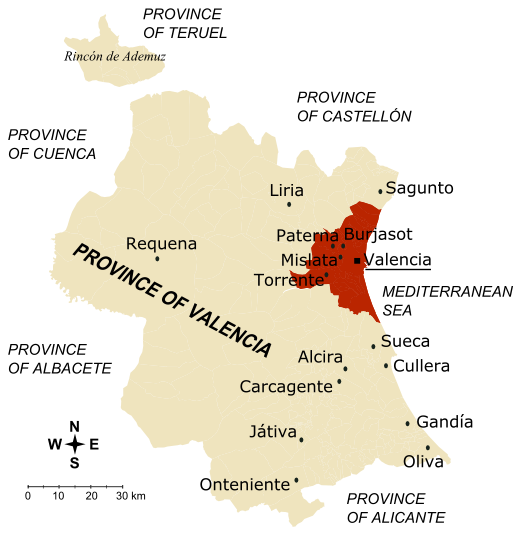
The Province of Valencia lies on Spain's eastern seaboard and forms the central province of the autonomous Valencian Community. It is one of three provinces in the community and had roughly 2.5 million inhabitants in recent counts. About one third of the province's population live in the capital, the city of Valencia, which is also the capital of the autonomous community and one of the largest cities in Spain.
Image gallery
2 Images
Geography and environment
The province stretches from the Mediterranean coast inland to a varied interior of plains and low mountain ranges. Coastal features include sandy beaches, harbors and the Albufera lagoon south of Valencia, an important wetland and rice-growing area. The climate is typically Mediterranean: mild, wet winters and hot, dry summers that support citrus orchards, vineyards and irrigated crops.
History and development
Human settlement in the area dates back to ancient Iberian and Roman times; the Roman foundation of Valentia gave the provincial capital its name. The territory experienced Visigothic and Islamic rule in the early Middle Ages and was incorporated into the Christian Kingdom of Valencia during the 13th century reconquest. Modern administrative structures were shaped in the 19th century when Spain reorganised provinces.
Economy and infrastructure
Valencia's economy blends agriculture, industry, commerce and tourism. The fertile coastal plain produces citrus fruits, vegetables and rice, while the port of Valencia is one of the busiest in the western Mediterranean and a major freight and passenger hub. Manufacturing, services and seasonal tourism along the Costa de Valencia are also important sources of employment.
Culture and identity
Valencian culture combines Spanish and regional traditions. Two languages are commonly used: Spanish and Valencian (a variety of Catalan) which are co-official in regional institutions. The province is famous for culinary traditions such as paella, and for vibrant festivals—most notably the Fallas of Valencia city—alongside historical architecture and contemporary landmarks like the City of Arts and Sciences.
Administration and notable features
- Part of the Valencian Community and administratively distinct from the autonomous government based in Valencia city.
- Protected areas include wetlands and coastal reserves such as the Albufera Natural Park.
- Main centers: Valencia (the capital), and numerous smaller towns and coastal resorts that support agriculture and tourism.
The Province of Valencia is therefore a region of contrasts: a densely populated urban centre at its heart, productive agricultural plains, important maritime infrastructure, and a strong cultural identity that attracts visitors and shapes local life.
Related articles
Author
AlegsaOnline.com Province of Valencia (València) Leandro Alegsa
URL: https://en.alegsaonline.com/art/79717