
Proportionality: direct and inverse relationships in mathematics and applications
Proportionality describes multiplicative relationships between quantities: direct (x ∝ y) or inverse (xy = constant). Explains forms, constant of proportionality, graphs, examples, and key distinctions.
Proportionality is a basic mathematical concept describing when two quantities change in a fixed multiplicative way. In a proportional relationship the value that links the quantities does not depend on their magnitude: one quantity is either a constant multiple of the other (direct proportionality) or their product is constant (inverse proportionality). Proportional reasoning is widely used in science, engineering, everyday calculations and education.
Image gallery
1 Image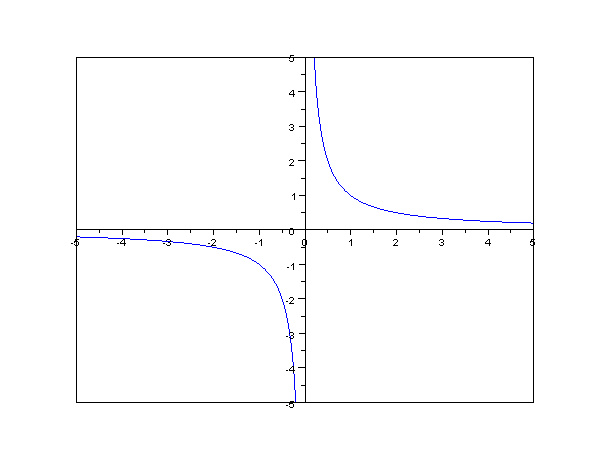
Basic forms and notation
The most common forms are written without heavy notation: direct proportionality is shown as x ∝ y, which means there exists a constant k so that x = k y. Inverse proportionality means x y = k for some fixed k, or equivalently x = k / y. The number k is called the constant of proportionality and may carry units derived from the variables it relates.
Characteristics and graphs
- Direct proportionality produces a straight line through the origin on a Cartesian plot (slope = k).
- Inverse proportionality yields a hyperbola: as one variable increases, the other decreases so their product remains constant.
- Proportionality requires the zero point to be preserved: if y = 0 then x = 0 in a direct proportional relationship.
Examples and applications
Simple numerical problems illustrate the idea: if x ∝ y and x = 10 when y = 2, then k = 5 and x = 5y for any y. Practical examples include map scales and recipes (direct proportion), or physical laws that fall off with distance, such as idealized inverse-square laws where quantity ∝ 1/r^2 (an inverse-type relationship). In engineering and physics, proportional models like Hooke's law or Ohm's law are linear proportionalities valid within specified regimes.
History, distinctions and cautions
Proportional reasoning has roots in classical mathematics and has been formalized over centuries. It differs from related ideas: proportionality is stronger than correlation (which only measures association) and different from general linear relationships that include an intercept (y = a + b x) — those are not proportional unless the intercept a is zero. Also, constant k depends on chosen units: changing units alters its numeric value but not the underlying relationship.
For concise treatments and exercises see elementary explanations or technical notes on modeling and units at applied references.
Related articles
Author
AlegsaOnline.com Proportionality: direct and inverse relationships in mathematics and applications Leandro Alegsa
URL: https://en.alegsaonline.com/art/79462