
Prithvi — the Earth goddess in Hindu tradition
Prithvi is the personification of the Earth in Hindu tradition, venerated as a mother goddess of fertility, stability and nourishment, with roots in Vedic literature and roles in later Puranic stories.
Overview
Prithvi (Sanskrit for "earth" or "broad one") is the ancient personification of the Earth in classical Indian religious thought and is an important goddess within Hinduism. She embodies the sustaining, fertile and receptive aspects of the natural world and is commonly addressed as a mother figure who supports life and agriculture.
Image gallery
7 Images


Names, attributes and iconography
She appears under several epithets such as Bhūmi, Bhūmidevī, Dharitri, Vasundharā and Prithvi Mata. Iconography varies by region and period: she may be depicted as a serene woman often shown with vegetation, fruits, or a pot representing abundance. In some depictions she sits on a lotus or on the back of the boar avatar of Vishnu, reflecting particular narrative associations.
Textual origins and development
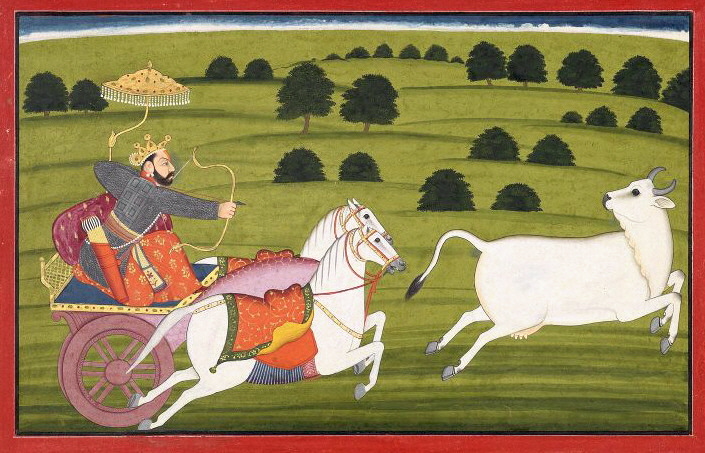
Prithvi has roots in the Vedic corpus where the earth is addressed as a life-giving mother and paired with the sky (Dyaus) as a complementary cosmic couple. Over centuries the figure appears in later Puranic and devotional literature, where Bhūmi or Bhūmidevī gains specific roles in legends — for example, narratives in which she is rescued or restored by a deity emphasize her relation to cosmic order and divine protection.
Religious practice and cultural importance
Prithvi is honoured in rites that acknowledge the sanctity of the ground and the responsibilities of humans toward it. Practical observances include ceremonies before building or agricultural work (often called bhūmi pūjā) and offerings connected to fertility and harvest. Her image and symbolism are invoked in prayers addressing sustenance, stability and the well-being of the community.
Symbolism, ecology and related concepts
As the elemental principle of earth, Prithvi corresponds to one of the five classical elements (pañca-bhūta) and represents solidity, support and the material foundation of life. She is often compared to other earth-mother archetypes in world traditions, serving both religious and ethical roles that reinforce care for land and resources.
Notable distinctions
- Prithvi vs. Bhūmi/Bhūmidevī: terms are frequently interchangeable, but local traditions may emphasize different aspects or narratives.
- Relation to major deities: in some Vaishnava narratives Bhūmidevī is identified with a consort-like figure connected to Vishnu’s preserving activity.
- Vedic to Puranic shift: the goddess’s representation moves from poetic cosmic presence in the Vedas to more narrative, devotional roles in later texts.
Understanding Prithvi offers insight into how sacred geography, agricultural practice and moral duties toward the environment have been interwoven in South Asian religious life.
Related articles
Author
AlegsaOnline.com Prithvi — the Earth goddess in Hindu tradition Leandro Alegsa
URL: https://en.alegsaonline.com/art/79266