
Pictor (constellation)
Pictor is a small southern constellation representing a painter's easel. It is best known for the nearby star Beta Pictoris with its debris disk and directly imaged exoplanets and for several faint galaxies.
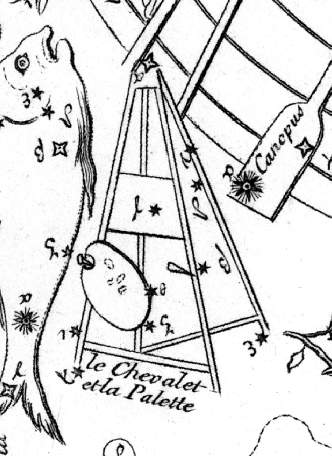
Pictor is a constellation in the southern celestial hemisphere whose name means "painter" or specifically a painter's easel. It is one of the modern constellations introduced during the 18th-century mapping of the southern skies and is relatively small and faint compared with classical northern constellations. As a recognized pattern of stars it is catalogued among the 88 official constellations; see constellation for a general definition.
Image gallery
6 Images




Characteristics
Pictor contains a modest number of naked-eye stars and a richer population of fainter stars visible with binoculars or small telescopes. The most familiar star to amateur and professional astronomers in this area is Beta Pictoris, a young star surrounded by a pronounced circumstellar debris disk. That system has been intensely studied because it provides a nearby laboratory for understanding planet formation and disk dynamics. Other named and cataloged stars in Pictor include several double or multiple systems and variable stars that interest observers.
History and name
The constellation was created in the 18th century by astronomers mapping the southern sky from the Southern Hemisphere. Its Latin name, Pictor, refers to the painter's easel or palette used by artists. The choice reflects a period when many new constellations were introduced to fill gaps in the southern celestial sphere with familiar tools, instruments, and objects rather than classical mythological figures.
Notable objects
- Beta Pictoris — A young, nearby star surrounded by a bright, edge-on debris disk. The system is famous for showing direct evidence of planet formation, including protoplanetary structures and at least one directly imaged exoplanet.
- NGC 1705 — A compact dwarf galaxy often cited as a starburst system; it is one of the brighter deep-sky galaxies located within the boundaries of Pictor and of interest for studies of stellar populations and galactic winds.
- Various faint galaxies and star clusters — Pictor hosts a number of galaxies and loose clusters that require moderate to large amateur telescopes to observe.
Observing Pictor
Pictor is best seen from the Southern Hemisphere or lower northern latitudes. Because it contains few very bright stars, it is not prominent to casual stargazers but becomes rewarding under dark skies and with optical aid. Observers often point small telescopes toward Beta Pictoris to study its disk or to search for faint companions and background galaxies within the constellation's borders.
Related articles
Author
AlegsaOnline.com Pictor (constellation) Leandro Alegsa
URL: https://en.alegsaonline.com/art/76748