
Peggy Sue Got Married
1986 American romantic fantasy comedy-drama directed by Francis Ford Coppola, starring Kathleen Turner and Nicolas Cage; a nostalgic time-travel story about memory, marriage and second chances.
Peggy Sue Got Married is a 1986 American romantic fantasy comedy-drama film directed by Francis Ford Coppola. The picture stars Kathleen Turner as the title character and features Nicolas Cage in a supporting role. It combines humor and bittersweet reflection with a modest dose of speculative time-travel to examine choices made in youth and their consequences in middle age.
Image gallery
1 Image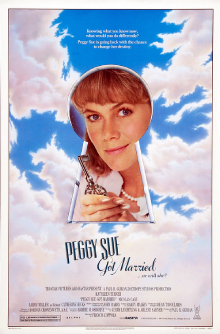
Premise and themes
The central premise follows Peggy Sue Bodell, who at a high-school reunion in the mid-1980s suddenly finds herself transported back to her teenage years around 1960. The narrative uses the time-displacement device to explore themes of memory, regret, marriage, identity, and the ways adults reinterpret their past. Rather than a hard science-fiction approach, the film prioritizes character, mood, and social detail of the late 1950s and early 1960s.
Cast and characters
- Peggy Sue Bodell — the protagonist who reassesses her life and marriage.
- Key supporting roles — include Peggy Sue’s teenage acquaintances and her husband, played in a manner that highlights interpersonal tensions and possibilities for change.
Production and style
Under Coppola’s direction the film balances nostalgic design elements with intimate performances. Costume and set choices evoke the era Peggy Sue revisits, while the screenplay emphasizes personal crossroads rather than spectacle. The combination of comedy and melancholy gives the film a tone that is reflective rather than purely escapist.
Reception and legacy
On release the film attracted critical attention for its lead performance and for its imaginative handling of nostalgia. It helped cement Turner’s dramatic reputation and remains notable in the careers of both Turner and Cage. The picture is often discussed in surveys of 1980s cinema that treated memory and time as central themes.
For further context on genre, direction and performers consult general resources about the film’s style and era: director’s filmography, character studies, articles on time-travel in film and pieces about reunion narratives such as high-school reunion stories. Additional background and analyses may be found via general reference pages and film retrospectives.
Across its mix of humor, wistfulness and moral inquiry, Peggy Sue Got Married remains a commonly cited example of 1980s films that revisit mid-century America to ask how much of who we become can be reclaimed or rewritten.
Related articles
Author
AlegsaOnline.com Peggy Sue Got Married Leandro Alegsa
URL: https://en.alegsaonline.com/art/75459