
On Her Majesty's Secret Service (1969 film)
1969 Eon Productions James Bond film starring George Lazenby, directed by Peter R. Hunt, based on Ian Fleming's novel. Notable for Bond's marriage, a score by John Barry and Louis Armstrong's song.
Overview
On Her Majesty's Secret Service is the sixth film in the official James Bond series, released in 1969 by Eon Productions. It adapts Ian Fleming's novel of the same name and takes a more personal, sometimes darker tone than earlier entries. The picture marked a major casting change when Australian model and actor George Lazenby succeeded Sean Connery in the role of James Bond. It was directed by Peter R. Hunt and produced by the franchise team.
Image gallery
10 Images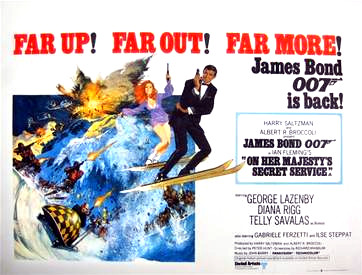


Cast and principal characters
The film's central figures include Diana Rigg as Tracy, Bond's love interest, and Telly Savalas as Ernst Stavro Blofeld, the head of SPECTRE. The primary cast is often listed to highlight the film's emotional stakes and its villain's scheme:
- George Lazenby as James Bond
- Diana Rigg as Tracy di Vicenzo
- Telly Savalas as Ernst Stavro Blofeld
Source material and plot themes
The screenplay draws on the Ian Fleming novel; Fleming's original work is the basis of the film's central romance and its depiction of Bond confronting a personal crisis. The antagonist operates a research clinic and pursues a scheme that risks mass harm, setting up a narrative of pursuit and personal sacrifice. The film is notable within the series for giving Bond a genuine romantic relationship that culminates in marriage, a departure from the series' usual episodic romances.
Music and notable contributions
John Barry composed the film's score, which balances action cues with sweeping romantic themes. A small but memorable vocal number, "We Have All the Time in the World," is associated with the film and is performed onscreen by Louis Armstrong; the song has since become one of the series' most affecting pieces. The movie title itself has been referenced and discussed widely in Bond histories and music retrospectives.
Production, release and legacy
Filming took place in multiple locations, including Alpine regions and coastal settings, and the production reflects late 1960s set and costume design. At the time of its release the film divided critics and audiences, in part because of the casting change and its more melancholic beats. Over subsequent decades it has been reappraised by many critics and fans for its emotional ambition and fidelity to elements of Fleming's novel. For further reading on the series and this entry, see general references on the James Bond film franchise and biographies of Ian Fleming and performers such as Louis Armstrong.
Notable fact: This remains the only Bond film to feature George Lazenby in the lead role; his single portrayal and the film's tragic turn set it apart in the series canon.
Related articles
Author
AlegsaOnline.com On Her Majesty's Secret Service (1969 film) Leandro Alegsa
URL: https://en.alegsaonline.com/art/72523