
On the Riviera (1951 film)
1951 American musical comedy directed by Walter Lang, starring Danny Kaye and Gene Tierney. A Riviera-set entertainment about show business, romance and mistaken identity; third screen adaptation and two-time Oscar nominee.
On the Riviera is a 1951 American musical comedy produced by 20th Century Fox and directed by Walter Lang. The film stars Danny Kaye and Gene Tierney and is the third cinematic treatment of the same underlying story. Released in the early 1950s, it blends light romantic farce with musical numbers and stage-bound show-business spectacle typical of studio-era entertainment.
Image gallery
1 Image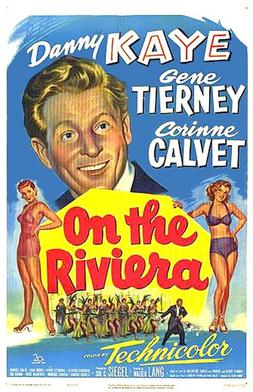
Plot and themes
The film centers on performers and romantic entanglements against the glamorous backdrop suggested by the French Riviera. Like many musicals of its era, the narrative relies on misunderstandings, doubled identities, and backstage antics to move between comic episodes and musical set pieces. Themes include the tensions between private life and public persona, the pressures of celebrity, and the interplay of romance and professional ambition.
Cast and production
- Danny Kaye — leading comic and singer, whose energetic physical comedy and musical versatility shape much of the film's tone.
- Gene Tierney — the principal female lead, providing the romantic counterpoint to Kaye's exuberance.
- Supporting players include Corinne Calvet, Marcel Dalio, Jean Murat, Henri Letondal and Sig Ruman, among others.
Walter Lang, a director associated with large-scale studio musicals, guided the production. The film was distributed by 20th Century Fox and reflects the polished production values and star-driven marketing typical of that studio period.
Music, style and staging
Musical comedies of this kind emphasize set-piece numbers, choreography and arrangements designed to showcase the star. Dance sequences and orchestral accompaniment alternate with comic bits and patter songs to maintain a brisk tempo. Costumes and studio settings aim to evoke the Riviera's glamour more through stylized production design than on-location realism.
Reception and legacy
Upon release the picture drew attention largely for Danny Kaye's performance and the film's production values. It earned two Academy Award nominations in 1952, underscoring its recognition within the industry. Over time the movie has been remembered as part of the postwar American musical tradition and as an example of studio-era comedy that married star personality to lavish entertainment.
As a remake of an earlier property, the film also illustrates Hollywood's practice of reworking proven stories for new audiences. It remains of interest to viewers studying midcentury musicals, the careers of its principal performers, or the way popular cinema represented leisure and celebrity in the early 1950s.
Questions and answers
Q: Who directed the movie 'On the Riviera'?
A: The movie 'On the Riviera' was directed by Walter Lang.
Q: When was the movie 'On the Riviera' released?
A: The release year of the movie 'On the Riviera' is 1951.
Q: Who are the main cast members of 'On the Riviera' movie?
A: The main cast members of 'On the Riviera' movie are Danny Kaye, Gene Tierney, Corinne Calvert, Marcel Dalio, Jean Murat, Henri Letondal, Sig Ruman.
Q: What is the genre of 'On the Riviera' movie?
A: 'On the Riviera' movie is a musical comedy.
Q: How many Academy Awards was the movie 'On the Riviera' nominated for?
A: The movie 'On the Riviera' was nominated for 2 Academy Awards in 1952.
Q: Who distributed the movie 'On the Riviera'?
A: The movie 'On the Riviera' was distributed by 20th Century Fox.
Q: Is the 1951 movie 'On the Riviera' the first adaptation of the same story?
A: No, the movie 'On the Riviera' is the third adaptation of the same story.
Related articles
Author
AlegsaOnline.com On the Riviera (1951 film) Leandro Alegsa
URL: https://en.alegsaonline.com/art/72533