
Note-taking: methods, history, and practical uses
A concise guide to note-taking: what it is, common methods and tools, historical development, practical uses, and tips to make notes more effective.
Overview
Note-taking is the practice of recording information taken from another source to capture ideas, facts, or impressions for later use. People take notes from spoken presentations, written texts, meetings, research, or fleeting thoughts. The purpose is to externalize memory so the writer does not need to hold every detail in mind; notes act as a personal record and working document. For the general idea of capturing content from an external origin see source, and for the role of notes in later memory consult concepts of recall.
Image gallery
3 Images
Parts and characteristics
Notes vary in form and level of detail. Typical components include brief headings, keywords, short phrases, diagrams, timestamps, and bibliographic markers. They may be handwritten in notebooks, sketched on index cards, or created digitally in apps that support text, images and links. Effective notes are legible, organized, and tailored to the writer's goals—reference, study, synthesis, or action.
Common methods
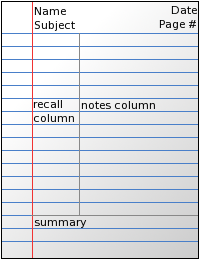
- Cornell method: divides a page into cues, notes, and summary to promote review.
- Outline: uses hierarchical headings and indentation for structured content.
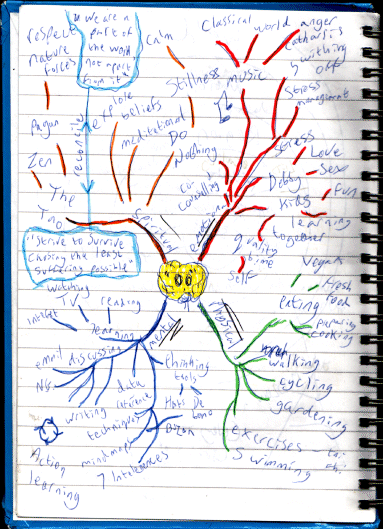
- Mind maps and concept maps: show relationships visually for brainstorming and complex topics.
- Charting: records parallel information across columns, useful for comparisons.
- Sentence method: records each idea as a separate line for fast speech capture.
History and development
Keeping notes is ancient: scholars and clerks recorded observations on papyrus, parchment and paper long before printing. Over time, shorthand systems and index cards were developed to speed capture and retrieval. The printing press and libraries changed how notes were used for research; more recently, personal computers and mobile devices transformed note-taking into a searchable, shareable activity and introduced new workflows for tagging and syncing information.
Uses and examples
Notes serve many roles: study aids for students, minutes and action lists from meetings, research logs for academics, design sketches for creative work, and personal journals for reflection. In meetings notes are often distilled into formal minutes; in lectures they support revision and exam preparation. Digital notes may be shared or archived, while handwritten notes are often valued for cognitive benefits tied to manual encoding.
Distinctions and notable facts
Notes differ from full transcripts, which capture everything verbatim, and from annotations, which comment directly on a text. They can be private or collaborative; legal and professional contexts sometimes require formalized note formats. Oral sources such as spoken presentations often require rapid capture strategies—when recording speech is impossible, efficient shorthand and selective listening become essential oral.
Practical tips
To make notes more useful: review and edit them soon after capture, add summaries and questions, use consistent abbreviations and tags, organize with indexes or folders, and back up digital notes. Regular review turns notes into organized knowledge rather than a disordered archive.
Related articles
Author
AlegsaOnline.com Note-taking: methods, history, and practical uses Leandro Alegsa
URL: https://en.alegsaonline.com/art/71160
Sources
- idemployee.id.tue.nl : idemployee.id.tue.nl/g.w.m.rauterberg/amme/makany-et-al-2008.pdf