
Natural monopoly
A natural monopoly arises when a single firm can supply an entire market more efficiently than multiple firms, typically because of large fixed costs and strong economies of scale.
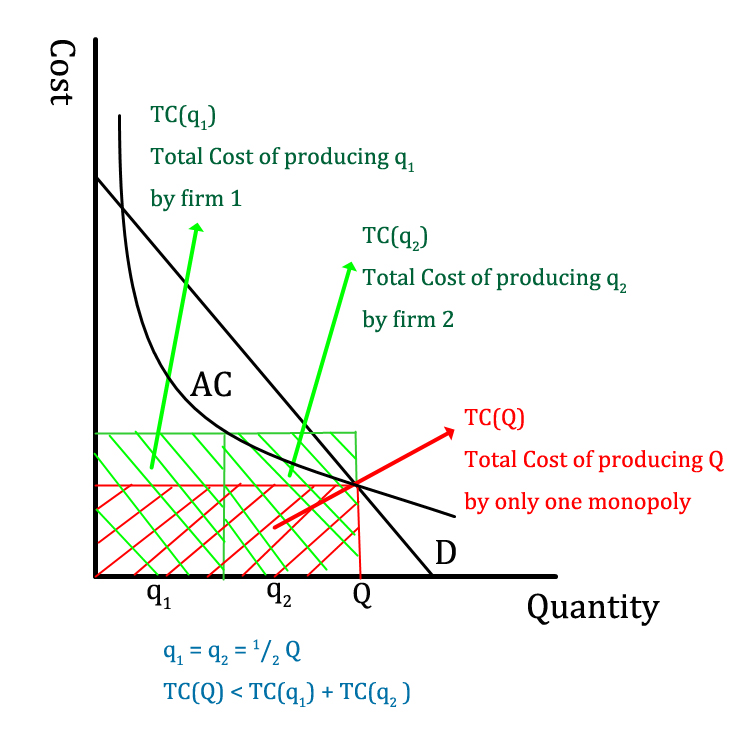
A natural monopoly describes a market situation in which one firm can serve all customers more efficiently and at lower average cost than any combination of two or more smaller firms. This condition typically follows from very large fixed or infrastructure costs and comparatively low marginal costs for producing additional units. Because a single producer captures most or all of the cost advantages, entry by competitors is often uneconomic; see a basic definition here.
Image gallery
2 Images
Characteristics
Natural monopolies share several identifiable features that distinguish them from other monopoly types.
- High fixed costs: Large upfront investments in physical networks, plants, or systems dominate total costs.
- Declining average costs: Average cost per unit falls across the entire range of market demand so that one provider enjoys scale advantages.
- Low marginal costs: Producing an extra unit is relatively cheap once infrastructure exists, encouraging a single large provider.
- Barriers to entry: The cost and complexity of duplicating infrastructure deter new firms from entering the market; for a discussion of market entry issues see this source.
Origins and development
The concept arose from observations in industries where networks or capital-intensive systems were more efficient when not duplicated. Economists in the late 19th and 20th centuries formalized the idea to explain why certain services—from pipes to power lines—were typically supplied by single firms. Technological change, regulation and public policy have since influenced how natural monopolies evolve and whether they remain single suppliers over time. For analysis of historical regulatory responses, consult related material.
Examples and importance
Classic examples include utilities that deliver water, electricity, natural gas or sewer service: the infrastructure costs make multiple parallel networks inefficient. Other examples can include rail networks, postal delivery in some contexts, and certain telecom infrastructures. The precise classification can vary by location and technology — for instance, advances in wireless and distributed technologies may weaken the single-provider advantage in some telecom markets. A practical overview of utility sectors is available at this link.
Regulation, policy responses and distinctions
Because natural monopolies can charge prices above competitive levels and reduce consumer welfare, governments commonly intervene. Typical approaches include public ownership, price regulation (rate-of-return, price caps), franchising, or allowing competition in retail while regulating the network. Regulators balance incentives for efficient operation with protections against excessive pricing. For policy frameworks and regulatory tools, see further reading.
Not every market dominated by a single seller qualifies as a natural monopoly: a distinction must be made between monopolies caused by legal privilege, strategic behavior, or network effects and those rooted primarily in cost structure and economies of scale. Understanding the underlying cause is essential for choosing an appropriate public policy response.
Related articles
Author
AlegsaOnline.com Natural monopoly Leandro Alegsa
URL: https://en.alegsaonline.com/art/68773