
National People's Army (Nationale Volksarmee, NVA)
The National People's Army was the armed forces of the German Democratic Republic (East Germany), created in 1956, structured on Soviet principles and disbanded at German reunification in 1990.
Overview
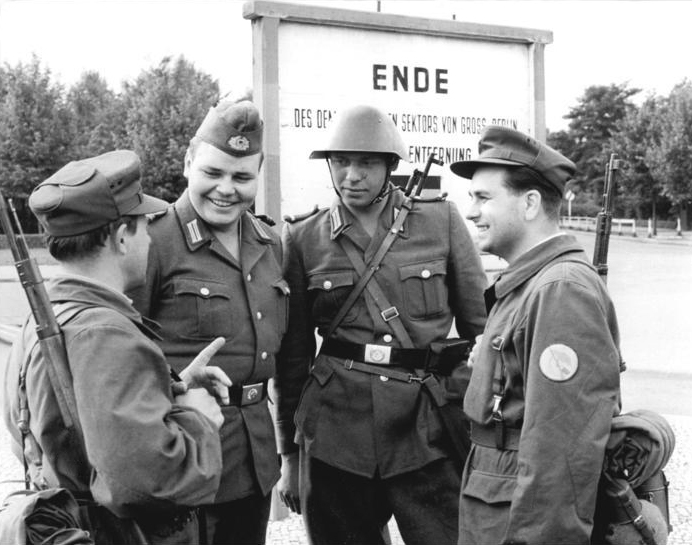
The National People's Army, known in German as the Nationale Volksarmee (NVA), served as the military of the German Democratic Republic (GDR or East Germany). Created after World War II during the Cold War, it was a standing, primarily conventional force intended to defend the GDR and to operate alongside Warsaw Pact allies. Its organization, doctrine and equipment reflected close alignment with the Soviet Union and the wider Eastern Bloc.
Image gallery
10 Images


Organization and branches
The NVA was a centrally controlled force with a hierarchical officer corps. It consisted of several principal branches and formations, commonly grouped as:
- Land forces (army units responsible for ground operations)
- Air Forces and Air Defence (aircraft, air defence systems and related support)
- People's Navy (coastal defence, patrol and naval units)
- Border troops and internal units tasked with frontier security and certain internal duties
Within this structure, commissioned officers exercised primary leadership, while the non-commissioned officer system operated differently from many Western militaries, with more limited autonomous authority for NCOs.
Origins and development
The NVA formally came into existence on 1 March 1956. It evolved out of the earlier Kasernierte Volkspolizei (barracked people's police), a paramilitary formation established in the early 1950s. Initially a volunteer force, the GDR introduced compulsory military service on 24 January 1962; conscription applied to male citizens within a specified age range and required a period of active duty, which shaped generations of East German men and the society they returned to.
Doctrine, political control and equipment
Doctrinally the NVA was modeled on Soviet military thinking: emphasis on centralized command, combined-arms operations and integration with Warsaw Pact plans. Political reliability was a central concern: political officers and party representatives were embedded within units to secure loyalty to the state and to the Socialist Unity Party (SED). The role of these political cadres was to ensure the armed forces remained aligned with the policies of the ruling political party and to monitor morale and ideology. The NVA used primarily Soviet-supplied weapons, vehicles and aircraft, and training stressed interoperability with allied forces.
Service, society and end of the NVA
Conscription (mandatory military service) made service a common experience for East German males; alternatives for those objecting were limited and subject to political and administrative review. By the late 1980s the NVA reached its peak size, numbering about 175,000 personnel. With the political changes of 1989–1990 and German reunification, the NVA was dissolved. Some personnel were transferred into the armed forces of reunified Germany, while much equipment was returned to Warsaw Pact suppliers, sold, mothballed or scrapped.
Distinctions and notable features
Key differences between the NVA and its West German counterpart included the visible role of political officers, the relative status and autonomy of non-commissioned officers (NCO) and the degree of party oversight. Comparisons were often drawn with the West German Bundeswehr in discussions of doctrine, civil-military relations and professional development. Observers also noted how the NVA's internal structures sought to guarantee loyalty to the state, reflecting broader patterns of governance in the GDR.
Related articles
Author
AlegsaOnline.com National People's Army (Nationale Volksarmee, NVA) Leandro Alegsa
URL: https://en.alegsaonline.com/art/68676