
Socialist Unity Party of Germany (SED): history, structure, and legacy
Overview of the Socialist Unity Party of Germany (SED): formation in 1946, role as the ruling party of East Germany (1949–1990), organization, policies, decline and successor parties.
Overview
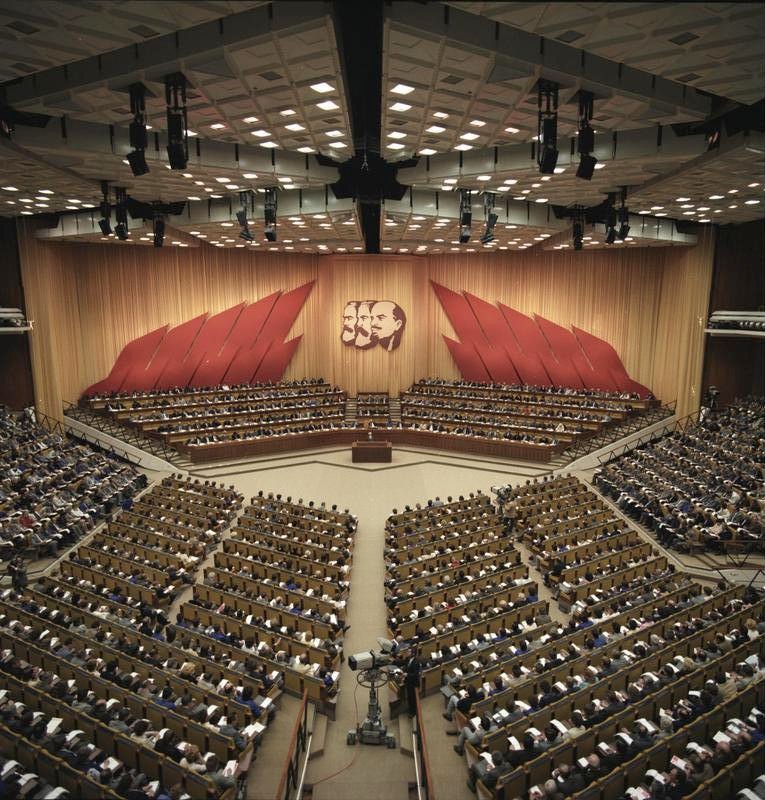
The Socialist Unity Party of Germany (Sozialistische Einheitspartei Deutschlands, commonly abbreviated SED) was the dominant political party in the German Democratic Republic (commonly called East Germany). Formed in the aftermath of World War II, the SED led the state from the creation of the GDR in 1949 until the political changes that culminated in free elections in 1990. It defined itself as a Marxist–Leninist party and organized both the party apparatus and the state around its leadership and ideology.
Image gallery
10 Images




Origins and formation
The party emerged from a forced and politically engineered merger of the Communist Party and the Social Democratic movement in the Soviet occupation zone. In April 1946, representatives of the Communist Party of Germany and the Social Democratic Party of Germany in the Soviet zone agreed—or were compelled—to unite, creating a single party intended to prevent a divided left and to facilitate reconstruction under Soviet influence. The alliance took place in a context shaped by the defeat of Nazi Germany and the outlawing of the Nazi Party, and within an occupying zone administered by the Soviet Union. Many surviving social democrats and communists participated, though the merger was controversial and later criticized as undemocratic by opponents.
Organization and ideology
Structurally, the SED followed the model of other communist parties of the era. It relied on a Central Committee, a Politburo of top leaders, and a General Secretary who held de facto supremacy in party and state affairs. The party claimed to represent the working class and rural workers, advocating nationalization of major industries, collectivization of agriculture, and a centrally planned economy. In practice, party decisions guided government policy, media, education, and cultural life. The SED maintained close links with the state security service and worked to suppress political dissent through surveillance, censorship, and repressive measures.
Role in the German Democratic Republic
After the GDR was formally established in 1949, the SED became the core of the single-party system. It shaped economic policy, directed the pace of industrialization and social programs, and implemented land reform and nationalization in the early postwar years. The party also framed the official memory of the Nazi past and presented the East German state as an antifascist, socialist alternative to the Federal Republic of Germany. The SED maintained sub-organizations for youth, women, and trade unions and exerted influence over churches, universities, and cultural institutions. A branch operated in Berlin and, until later separation, in West Berlin as well; the West Berlin organization later existed as a related formation with similar aims.
- Key features: one-party rule, Marxist–Leninist ideology, centralized planning.
- State control: coordinated media, education, and security services.
- Social policy: emphasis on full employment, social welfare, and mass housing programs.
Decline, reform and successor parties
By the late 1980s the SED faced mounting economic problems, public discontent, and changing international dynamics. Reform efforts were impeded by the party’s entrenched bureaucracy and by tensions over how to respond to political change in the Soviet Union. As Soviet leader Mikhail Gorbachev promoted policies of perestroika and glasnost, the SED leadership was divided about adopting similar reforms. Widespread protests in 1989 and pressures for democratic change forced the party to relinquish its monopoly on power. In 1989–1990 the SED abandoned many of its old practices, rebranded itself as the Party of Democratic Socialism, and later became a foundational element of contemporary left-wing formations in unified Germany. Its successor organizations continued to participate in regional and national politics and to influence debates about social policy.
Notable facts and distinctions
The SED’s legacy is contested: supporters emphasize social gains such as expanded education, healthcare, and employment guarantees, while critics point to human-rights abuses, restricted freedoms, and economic inefficiencies that contributed to the state’s collapse. The SED maintained a separate organization for West Berlin after 1962, known as the Socialist Unity Party of West Berlin, which shared ideology with the East German party but operated under different legal and political constraints. Over time, former members and critics have debated the degree to which the 1946 merger reflected voluntary political unity versus coercion under occupation.
For more detailed information and archival materials, readers can consult historical collections, contemporary analyses of Cold War politics, and studies of postwar German party development. Additional context about the Social Democratic Party involved in the merger is available through sources that discuss the SPD history; the city where the merger took place is often referenced in urban histories of Berlin. The party’s later political partnerships and figures—names connected to the post-SED left—are discussed in accounts that mention politicians such as Oskar Lafontaine and electoral alliances of the 2000s. Coverage of the party’s Soviet-era orientation may be explored alongside materials about the Soviet Union and the way Western sectors of Germany and West Berlin related to East German institutions.
The SED remains a significant subject for understanding 20th-century German history, the dynamics of Stalinist- and Soviet-influenced parties in Europe, and the complex processes of democratic transition at the end of the Cold War.
Questions and answers
Q: What was the name of the governing party in East Germany?
A: The Socialist Unity Party of Germany (SED).
Q: When was it formed?
A: It was formed in April 1946, a year after World War II ended.
Q: How did it come into existence?
A: It was created when the Soviet Union forced members of the Social Democratic Party of Germany (SPD) and Communist Party of Germany (KPD) who lived in Soviet-occupied parts of Germany and Berlin to unite.
Q: What happened to the SED after 1990?
A: After 1990, the party reformed itself as the Party of Democratic Socialism (later in 2005, as The Left Party.PDS).
Q: Where is it still popular today?
A: It is still somewhat popular in parts of former East German territory, frequently winning seats at state and local elections.
Q: What did one famous SED poster say?
A: One famous SED poster read "To learn from Stalin means to learn how to win". Later, the word Stalin was replaced with USSR.
Q:What happened when Gorbachev became president of USSR ? A:When Gorbachev became president of USSR ,the famous slogan was abandoned ,as SED did not believe there was anything to learn from his ideas about perestroika .
Related articles
Author
AlegsaOnline.com Socialist Unity Party of Germany (SED): history, structure, and legacy Leandro Alegsa
URL: https://en.alegsaonline.com/art/91466