
Modular origami
Form of paperfolding where many identical folded units are assembled into larger geometric and decorative structures; uses pocket-and-flap connections and often produces polyhedral or spherical forms.
Overview
Modular origami, also called unit origami, is a paperfolding technique in which multiple sheets are folded into identical units and then assembled to form a single larger structure. Instead of working from one large sheet, makers create many small modules that interlock by inserting flaps into pockets, by tucking edges together, or occasionally by using thread or adhesive for stability. The method enables constructions that would be difficult or impossible from a single sheet, and it is commonly used to create geometric polyhedra, decorative balls, and complex repeating forms.
Image gallery
9 Images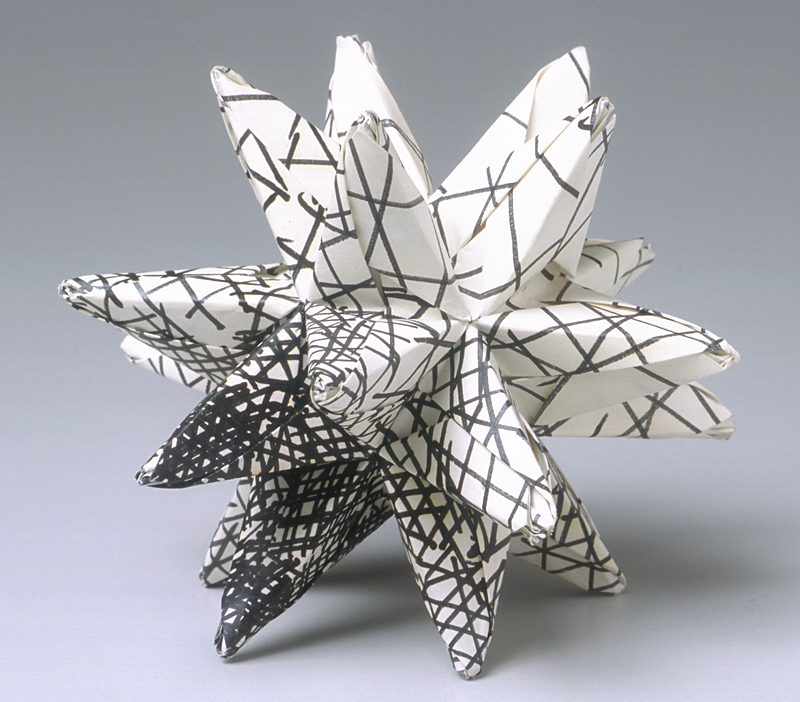


Characteristics and common units
Units are distinct, simple models folded from square or rectangular pieces of paper; their shape determines how they connect. Many modular designs rely on symmetric units so the assembled object has a clear geometric organization. Well-known unit types include the Sonobe-style unit and various kusudama-inspired petals. Paper choice — weight, size, and stiffness — affects fit and overall appearance: thin, crisp paper tucks more easily, while heavier paper can give a sturdier result.
Assembly and techniques
Assembly typically proceeds without glue: modules are linked by sliding tabs into pockets formed during folding, creating friction and tension that hold the model. Alternative methods use sewing or a dab of glue to secure fragile joints or to allow nonstandard geometries. Modular builders vary the number of units to change scale and topology; by altering unit geometry, they can realize different polyhedral nets and stellations.
History and cultural notes
The practice grew from traditional Japanese kusudama — decorative medicine-balls made by sewing folded flowers — to modern modular constructions emphasizing mathematical symmetry and recreational complexity. During the 20th century, artists and hobbyists developed many standardized units and explored connections to polyhedral geometry, often publishing instructions and patterns in books and magazines.
Uses, examples and significance
Modular origami serves both artistic and educational purposes. It is popular for decorative objects, teaching spatial reasoning, and illustrating concepts in symmetry and topology. Typical examples include assembled spheres, polyhedral models that demonstrate Platonic and Archimedean shapes, and elaborate multi-module sculptures. Communities of folders share diagrams and photos online, and introductory patterns and tutorials often begin with a handful of units so beginners can learn basic tucking and connection techniques. For practical resources and step-by-step guides see additional references.
Related articles
Author
AlegsaOnline.com Modular origami Leandro Alegsa
URL: https://en.alegsaonline.com/art/65733