
Mir Jafar: Nawab of Bengal and his role in the establishment of British power
Syed Mir Jafar (c.1691–1765), a Bengali military leader who became Nawab after the Battle of Plassey (1757). His alliance with the British altered Bengal's politics and left a contested legacy remembered as betrayal.
Overview
Syed Mir Jafar Ali Khan Bahadur (c. 1691 – 5 February 1765), commonly called Mir Jafar, was a Muslim military officer who became Nawab of Bengal after the pivotal Battle of Plassey in 1757. He is a historically significant figure because his cooperation with the British East India Company helped bring about a lasting change in the political control of Bengal and, more broadly, in South Asia. Historians treat his actions as central to the start of sustained British influence in the region.
Image gallery
6 Images




Background and rise
Born into a family of Syeds in eastern India, Mir Jafar rose through the military ranks under Nawab Alivardi Khan and later served in the army of Nawab Siraj-ud-Daulah. By the mid-18th century he held a senior command and was widely regarded as a powerful subordinate with ambitions and grievances that made him a focal point for conspirators opposed to Siraj-ud-Daulah's rule.
Battle of Plassey and the pact with the Company
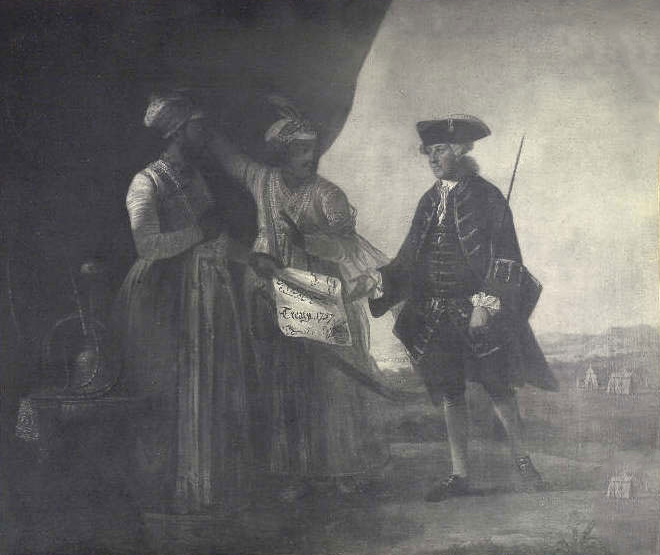
On 23 June 1757, at the Battle of Plassey, Mir Jafar entered into a secret agreement with Company officers led by Robert Clive. His withdrawal of troops from the battlefield and coordination with Company forces helped secure a decisive victory over Siraj-ud-Daulah. Contemporary and later accounts describe this arrangement as a betrayal of the Nawab and a turning point that enabled the Company to convert a commercial foothold into political authority.
Rule, removal, and restoration
After Plassey the Company installed Mir Jafar as Nawab. His rule was constrained by Company demands and payments; he found his authority limited and unpopular. In 1760 the Company briefly replaced him in favour of another nominee, Mir Qasim, though Mir Jafar was restored after subsequent military and political shifts. He spent his final years under continued Company influence and died in 1765.
Consequences and legacy
The immediate consequence of Mir Jafar's alliance was the consolidation of Company power in Bengal: control over revenue, administration and trade expanded markedly in the decades that followed. Economically and socially, these changes had profound effects on Bengal and played a part in the longer process that led to British colonial rule in India.
Memory, controversy and language
Mir Jafar's name has entered popular memory across South Asia as a symbol of treachery. In modern usage the term "mirjafar" in Bengali and the phrase "meer jafar" in Urdu are commonly invoked to label someone a traitor. The portrayal of Mir Jafar is contested: while many sources emphasize his personal ambition and political calculation, some stories and local traditions include sensational or exaggerated details which are not corroborated by reliable contemporary evidence. His reputation is also discussed in histories of colonial expansion and in the national narratives of countries such as Pakistan.
Key events
- c. 1691: Birth.
- 1756–1757: Political crisis in Bengal leading to the Battle of Plassey (Plassey).
- 23 June 1757: Battle of Plassey.
- 1757–1760 and 1763–1765: Periods during which Mir Jafar served as Nawab under Company influence.
Mir Jafar remains a complex historical figure: both an individual actor responding to immediate pressures and a symbol of the deeper shifts that brought colonial governance to South Asia.
Related articles
Author
AlegsaOnline.com Mir Jafar: Nawab of Bengal and his role in the establishment of British power Leandro Alegsa
URL: https://en.alegsaonline.com/art/65336