
Asclepias exaltata — poke (tall) milkweed
A native eastern North American milkweed with nodding greenish-white flowers, found in moist woodlands; valued for pollinators and used in shade-friendly native plantings.
Overview
Asclepias exaltata, commonly called poke milkweed or tall milkweed, is a perennial plant in the milkweed group (Asclepias) and belongs to the subfamily Asclepiadoideae. It is native to eastern North America and typically grows in shaded to partly shaded woodland settings. The species is known for its upright stems and softly nodding umbels of pale green to white flowers that bloom in late spring to early summer (bloom time).
Image gallery
3 Images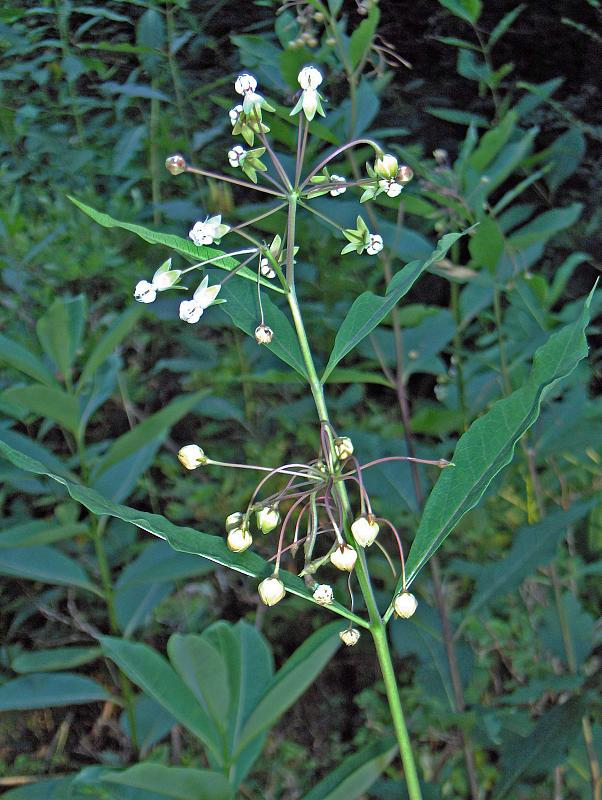


Identification and characteristics
Poke milkweed reaches about 0.6–1.5 m (2–5 ft) tall. Leaves are opposite, ovate, and often more open and fewer per stem than those of open-field milkweeds. Flower clusters are small, pendant, and less showy than the pink, globe-shaped clusters of Asclepias syriaca. Fruits are narrow follicles that release silky-haired seeds adapted for wind dispersal. The plant favors moist soil and tolerates rich, loamy conditions.
Habitat and distribution
Woodland and forest edges are the principal habitats for A. exaltata. In its native range it occupies mesic deciduous woods, stream banks, and shaded ravines where light is dappled rather than full sun. It can be incorporated into native plant gardens designed to mimic these conditions.
Ecology, uses, and cultivation
Like other milkweeds, poke milkweed is ecologically important: its flowers provide nectar for bees, butterflies, and other pollinators, and it serves as a larval host for monarch butterflies and other milkweed-dependent insects. Gardeners plant it for pollinator-support in shady wildflower borders. Propagation is commonly by seed or by dividing clumps in spring. Unlike some milkweeds, it is not typically aggressive in lawns or open fields.
Notable distinctions and background
- Flowers: nodding, greenish-white rather than large pink or purple clusters.
- Form: slender, taller stems suited to woodland understories.
- Human use: various milkweeds have historical uses for fiber and traditional remedies, though specific ethnobotanical roles of A. exaltata are less prominent.
For further botanical details, identification keys, or regional reports see resources linked here: species profile, milkweed overview, plant databases, subfamily notes, range maps, phenology, woodland ecology, habitat guides, and soil and moisture.
Author
AlegsaOnline.com Asclepias exaltata — poke (tall) milkweed Leandro Alegsa
URL: https://en.alegsaonline.com/art/6485