
Midnight Cowboy (1969 film)
Midnight Cowboy is a 1969 American drama film about friendship and survival in New York City, directed by John Schlesinger and notable for its awards, gritty realism and cultural impact.
Overview
Midnight Cowboy is a 1969 American drama film that follows the unlikely bond between two displaced men in New York City. Directed by John Schlesinger and released by United Artists, the screenplay by Waldo Salt adapts a novel by James Leo Herlihy. The picture combines naturalistic location shooting, a contemporary soundtrack and intimate performances to portray urban isolation, loyalty and the search for dignity.
Image gallery
1 Image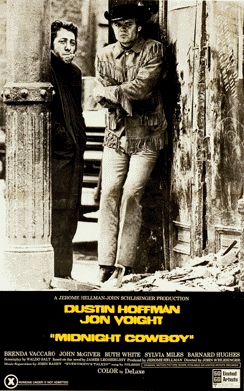
Cast and characters
The central relationship pairs a naive outsider with a cynical survivor. Jon Voight plays the title figure — often identified as Joe Buck — while Dustin Hoffman, coming off The Graduate, portrays the ailing con man often called Ratso Rizzo. Their chemistry and contrast drive the film’s emotional core.
- Jon Voight — lead role
- Dustin Hoffman — co-lead
- Supporting ensemble — a mix of professional actors and nonprofessionals
Production and release
Shot largely on location in New York, the film captures late-1960s street life with a raw, observational style. Its adaptation retained the novel’s melancholic tone while shaping scenes for cinematic immediacy. Upon release the movie provoked strong reactions for frank content and social realism; it earned both critical praise and controversy.
Reception, awards and legacy
Midnight Cowboy won multiple honors and remains a landmark of American cinema. It earned the Academy Award for Best Picture — a distinction noted in awards history — and recognition in directing and acting categories. The screenplay by Salt also received acclaim. The film was originally given an X rating and later reclassified by the MPAA, a change that has been discussed in studies of film censorship and classification.
- Academy Award — Best Picture winner
- Director recognition — noted for Schlesinger’s achievement
- Acting nominations — major nominations for Voight and Hoffman
Themes and significance
Beyond its plot, Midnight Cowboy is remembered for exploring poverty, friendship, and the underside of the American dream. It influenced later urban dramas and is frequently cited in discussions of 1960s filmmaking and shifting cultural norms. For further reading on the director, screenplay and novel, see resources linked to the film’s production and critical history.
Recommended starting points: John Schlesinger, Waldo Salt, James Leo Herlihy, and the careers of Dustin Hoffman and Jon Voight.
Related articles
Author
AlegsaOnline.com Midnight Cowboy (1969 film) Leandro Alegsa
URL: https://en.alegsaonline.com/art/64742
Sources
- news.bbc.co.uk : "BBC NEWS - In Depth - Oscars 2000 - Academy Awards A-Z"
- imdb.com : "IMDB.com: Awards for Midnight Cowboy"
- news.google.com : "Tri City Herald – Jul 6, 1969"