
Michelson interferometer
A precision optical instrument that splits and recombines light to measure small distances, wavelengths, refractive indices and phase shifts; central to metrology and the Michelson–Morley experiment.
Overview
The Michelson interferometer is a classical optical instrument that produces interference between two portions of a single light beam. By comparing the phase of light returning from two different paths, it converts tiny optical path differences into visible fringe patterns. Its simplicity, sensitivity, and direct relation between fringe shifts and path difference made it foundational for precision measurement in optics and physics.
Image gallery
8 Images




Design and operation
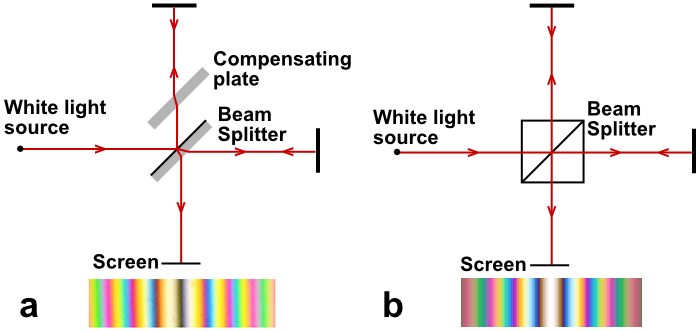
At its core the device splits an incoming beam with a partial reflector (beam splitter), sends the two resulting beams along separate arms to mirrors, and recombines them so that they interfere. A movable mirror changes one arm's length, producing a change in the interference pattern proportional to twice the mirror displacement. Typical components include:
- Beam splitter – divides and recombines the beam.
- Mirrors – return beams along the two arms.
- Compensator plate – equalizes glass thickness in each path when used.
- Detector or eyepiece – visualizes or records fringes.
Fringes, coherence and measurement
Interference fringes arise from the phase difference between the two recombined beams. With a monochromatic source the device produces high-contrast fringes whose spacing depends on alignment and path difference. Broadband or white-light sources show fringes only near zero path difference because of limited coherence length. By counting fringe shifts or analyzing fringe movement, one can determine wavelengths, small displacements, or changes in refractive index.
History and development
Albert A. Michelson developed and refined this type of interferometer in the late 19th century. Its most famous early application was the Michelson–Morley experiment (1887), which sought evidence for a luminiferous aether and had a null result that influenced later developments in physics. Michelson was awarded the Nobel Prize in Physics in 1907 for his precision optical instruments and spectroscopic investigations.
Uses and importance
Michelson interferometers are widely used in optical metrology: measuring wavelengths, calibrating standards, testing optical surfaces, and determining refractive indices or thickness of transparent samples. Variants and descendants of the Michelson arrangement form the basis of modern instruments, including interferometric techniques in spectroscopy and the core layout of large-scale detectors (modified Michelson configurations) used in precision experiments.
Distinctions and notable facts
The Michelson design differs from other interferometers such as Mach–Zehnder (which keeps the beams spatially separate) and Fabry–Pérot (which relies on multiple internal reflections). Its straightforward geometry and direct fringe interpretation make it a pedagogical and practical workhorse in laboratories, though sensitivity ultimately depends on wavelength, source coherence, and mechanical stability.
Related articles
Author
AlegsaOnline.com Michelson interferometer Leandro Alegsa
URL: https://en.alegsaonline.com/art/64547