
Mie scattering
Exact solution for light scattering by spherical particles. Describes how size, wavelength and refractive index determine scattering, absorption and angular patterns across many fields.
Mie scattering is the classical electromagnetic description of how an incoming plane wave of light interacts with a spherical particle. Unlike simple approximations that assume very small or very large particles, the Mie solution treats the full wave nature of light and yields exact scattering, absorption and extinction for a homogeneous sphere given its radius and complex refractive index. The theory explains why particles comparable to a wavelength scatter light differently from both tiny molecules and macroscopic objects.
Image gallery
4 Images


Core concepts
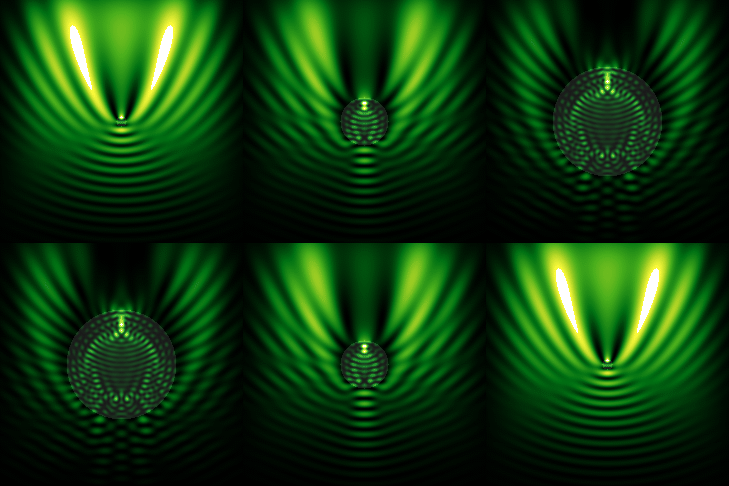
The analysis solves Maxwell's equations with boundary conditions at the sphere surface. Important parameters are the size parameter (proportional to particle radius divided by wavelength) and the complex refractive index (which encodes refraction and absorption). From the solution one obtains efficiency factors for scattering, absorption and extinction, plus the angular distribution of scattered intensity. Large particles tend to concentrate scattering in the forward direction; particles of intermediate size produce oscillatory angular patterns and resonant features.
History and relationship to other models
The method is named after Gustav Mie, whose work generalized wave scattering beyond the Rayleigh limit (valid when particles are much smaller than the wavelength). At the opposite extreme, when particles are much larger than the wavelength, geometric optics approximations become useful. Mie theory sits between these limits and provides an exact benchmark for spherical particles; many numerical and approximate methods are compared to its results.
Applications and examples
Mie scattering has practical importance across atmospheric science, optics and engineering. It explains why clouds and fog appear white rather than blue, how aerosol particles scatter sunlight, and how beads or droplets produce angle-dependent color. Instruments that size particles by optical scattering and models of light transport in tissues or colloidal suspensions routinely use Mie calculations. In photonics the same resonant scattering features underlie cavity modes and photonic resonances in microspheres.
Extensions and practical notes
Exact Mie formulas apply only to homogeneous spheres; more complex shapes or aggregates require extended methods such as T-matrix approaches or discrete-dipole approximations. Coated spheres and multilayered particles have analogous analytic solutions. Computational libraries implement the series expansions efficiently, but care is needed for numerical convergence at very large size parameters or highly absorbing materials.
- Basic introduction: overview and examples
- Mathematical derivation: series solution
- Applications in atmosphere and climate: aerosols and clouds
- Laboratory and biomedical uses: particle sizing
- Numerical methods and code: software and libraries
- Comparisons with Rayleigh and geometric optics: limits and approximations
- Further technical references: advanced reading
The Mie solution remains a foundation for understanding light–matter interaction at the mesoscale. For spherical particles it gives a complete, wavelength-dependent description that serves both theoretical insight and practical engineering needs.
Questions and answers
Q: What is Mie scattering?
A: Mie scattering is the way that light scatters when it hits an object.
Q: Who is Mie scattering named after?
A: Mie scattering is named after the German physicist, Gustav Mie.
Q: Is Mie scattering theory applicable to all wavelengths of light?
A: Yes, Mie scattering theory is good for all wavelengths of light.
Q: Can Rayleigh scattering theory be used for objects that are much smaller than the wavelength of light?
A: Yes, Rayleigh scattering theory is quite good for objects that are much smaller than the wavelength of light.
Q: Is Mie scattering theory applicable to all object sizes?
A: Yes, Mie scattering theory is applicable to all object sizes.
Q: When is light able to hit many places on a big object?
A: Light can hit many places on a big object.
Q: Is there a formula for Mie scattering?
A: Yes, there is a quite good formula for the scattering in Mie scattering theory.
Related articles
Author
AlegsaOnline.com Mie scattering Leandro Alegsa
URL: https://en.alegsaonline.com/art/64768