
Mesoarchaean (Mesoarchean): Earth 3.2–2.8 billion years ago
The Mesoarchaean (3.2–2.8 Ga) is the third era of the Archaean eon, characterized by early continental crust growth, stromatolite-forming microbial life, the Pongola glaciation, and supercontinent activity.
The Mesoarchaean (also spelled Mesoarchean) is the third major era within the Archaean eon. It spans roughly from 3.2 billion years ago to about 2.8 billion years ago. This interval sits after the Palaeoarchaean and before the Neoarchaean, and it records important changes in Earth's lithosphere, surface environments and early life.
Image gallery
5 Images



Key characteristics
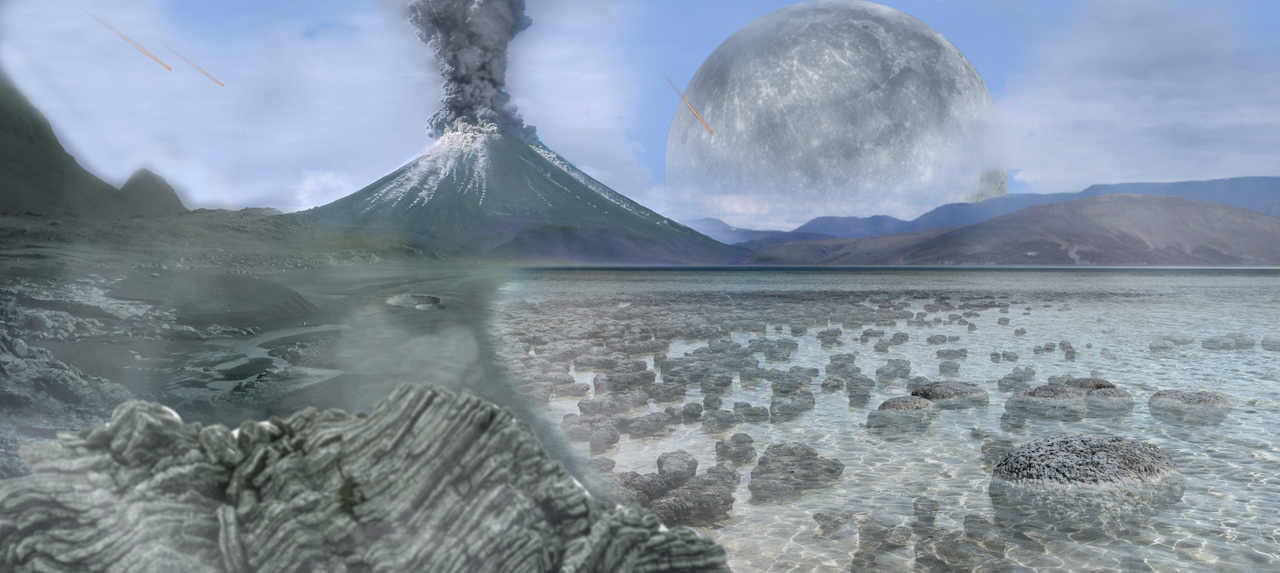
Rocks preserved from the Mesoarchaean are chiefly found in ancient cratons and greenstone belts. These rocks show evidence for continued growth and reworking of continental crust, including tonalite–trondhjemite–granodiorite (TTG) suites and volcanic successions. The climate was generally hot by modern standards, but the interval includes notable glacial events. Atmospheric oxygen remained very low compared with today, and most ecosystems were microbial and mat-dominated.
Major geological events
- Break-up of an early supercontinent often called Vaalbara is inferred around the start of the era, as ancient crustal fragments drifted apart.
- An early continental assembly known as Ur is reconstructed by some studies as present in the Mesoarchaean, though reconstructions remain debated.
- The Pongola glaciation (commonly cited around 2.9 billion years ago) is one of the oldest suspected glacial episodes and falls within this era.
- Evidence for changing tectonic regimes and erosion patterns appears in sedimentary basins and detrital zircons dated to this time.
Life and fossils
Fossil and sedimentary structures indicate that microbial communities, particularly stromatolite-forming mats, were widespread. Some of the oldest stromatolitic structures preserved in Archean strata date to the Mesoarchaean, showing layered microbial accretion in shallow waters. These communities played a central role in biogeochemical cycling of carbon, sulfur and other elements, even though biologically produced oxygen was still locally and globally limited.
Significance and scientific context
The Mesoarchaean is significant because it records a period when Earth's crust matured, early biospheric structures became widespread, and major tectonic and climatic episodes set the stage for later environmental change. Debates continue over the exact configuration and timing of Archean supercontinents and the causes and extent of early glaciations. Much of what is known about the era comes from radiometric dating, isotope geochemistry and careful field studies of well-preserved cratons and greenstone sequences.
Researchers often consult specialized literature and databases to follow ongoing revisions to Archean chronology; for introductory summaries and timelines see general geology resources (Archaean overview) and reviews that synthesize tectonic, sedimentary and biological evidence. Continued discoveries of ancient rocks and microfossil-like structures keep the Mesoarchaean a dynamic topic in Earth history.
For related topics and comparative context, readers may explore pages on the concept of a geologic era, the broader eon framework, and adjacent intervals such as the Palaeoarchaean and Neoarchaean. Further reading often treats the Pongola glaciation, the role of stromatolites, and hypotheses about early supercontinents like Vaalbara and Ur.
Related articles
Author
AlegsaOnline.com Mesoarchaean (Mesoarchean): Earth 3.2–2.8 billion years ago Leandro Alegsa
URL: https://en.alegsaonline.com/art/64085
Sources
- stratigraphy.org : stratigraphy.org/ICSchart/ChronostratChart2013-01.pdf
- pnas.org : "The Paleoproterozoic snowball Earth: A climate disaster triggered by the evolution of oxygenic photosynthesis"
- ui.adsabs.harvard.edu : 2005PNAS..10211131K
- doi.org : 10.1073/pnas.0504878102
- ncbi.nlm.nih.gov : 1183582
- pubmed.ncbi.nlm.nih.gov : 16061801