
Mesh networking: principles, types, and practical uses
Mesh networking is a decentralized network topology in which nodes relay data for one another. It supports redundancy and resilience, and is used in wireless LANs, IoT, emergency communications and ad hoc systems.
Overview
Mesh networking is a decentralized form of network topology in which nodes connect to multiple peers and forward data on behalf of others. Unlike a simple point-to-point or star layout, a mesh lets information traverse the network by hopping from node to node until it reaches its destination. This approach emphasizes fault tolerance and multiple delivery paths, so the network can keep functioning when individual nodes or links fail.
Image gallery
1 Image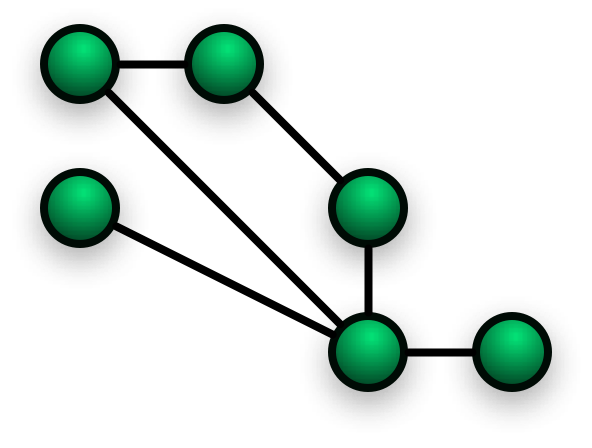
How mesh networks work
Each participant in a mesh acts both as an endpoint and as a router. When a node needs to send data it either forwards packets directly to a neighboring node or consults a routing mechanism to choose a path. Packets are handed off across successive nodes until they arrive at the target. Mesh designs vary in how many connections each node keeps: a fully connected mesh links every node to every other, while a partial mesh connects each node to a subset of neighbors to reduce cost and complexity. Mesh architectures are used in both wired and wireless contexts, including traditional computer networks and sensor deployments.
Variations and routing protocols
There are several common forms of mesh networking and corresponding routing strategies:
- Full mesh: every node directly communicates with all other nodes — high redundancy, high cost.
- Partial mesh: nodes connect to some, not all, peers to balance resilience and resource use.
- Mobile ad hoc networks (MANETs): nodes are mobile and links change frequently; the network adapts dynamically.
Routing in mesh environments can be proactive (maintaining up-to-date routes), reactive (discovering routes on demand), or hybrid. Protocols such as OLSR, AODV and various proprietary schemes address trade-offs between latency, bandwidth overhead and adaptability, while simpler techniques like flooding may be used in small or highly dynamic systems. Mesh networks also require mechanisms for link quality assessment, congestion control, and, often, power-aware routing in battery-powered devices.
Advantages and disadvantages
- Advantages: robust connectivity due to multiple paths, graceful degradation when components fail, and flexible deployment without fixed infrastructure.
- Disadvantages: increased complexity in routing and management, higher cost or use of radio spectrum for many links, possible latency from multi-hop paths, and greater security considerations because many nodes participate in forwarding.
Applications and examples
Mesh networking appears in many real-world scenarios. Wireless mesh systems are used to extend broadband coverage across neighborhoods, campuses, and disaster-affected areas. In the Internet of Things (IoT), mesh topologies let battery-powered sensors relay data to gateways. Emergency services and military units favor ad hoc mesh setups for rapid, infrastructure-free communications. Community networks, smart lighting, and industrial control systems also exploit mesh layouts for redundancy and scalability.
History, notable facts and distinctions
Research into packet radio and ad hoc routing in the late 20th century inspired many mesh concepts; later standardization and product development brought mesh into consumer Wi‑Fi and professional wireless systems. Economists and technologists sometimes discuss network value using heuristics such as Metcalfe’s Law (value ∝ n^2) and Reed’s Law (value grows faster with group-forming capabilities); these are conceptual ways to think about the importance of connectivity rather than strict measures. Important distinctions separate mesh from other topologies like star or bus networks: mesh emphasizes distributed forwarding and multiple redundant routes rather than central points of control. For technical details and protocol references, see the literature and resources linked below.
Further reading: technical surveys and standards, deployment guides, and community projects offer practical examples and deeper protocol explanations.
Related articles
Author
AlegsaOnline.com Mesh networking: principles, types, and practical uses Leandro Alegsa
URL: https://en.alegsaonline.com/art/64064