
Marine One — U.S. presidential helicopter call sign and operations
Marine One is the call sign for any U.S. Marine aircraft carrying the President. Operated by HMX‑1, the specially equipped helicopters serve short-range transport with strict security, communications, and logistics protocols.
Marine One is the radio call sign assigned to any United States Marine Corps aircraft carrying the President of the United States. The designation does not refer to a single airframe but to the mission: whenever the President is aboard a Marine aircraft it becomes Marine One. Likewise, a Marine aircraft carrying the Vice President uses the call sign Marine Two. These rules emphasize the call sign's role in identifying the presence of specific national leaders rather than naming a particular helicopter.
Image gallery
8 Images

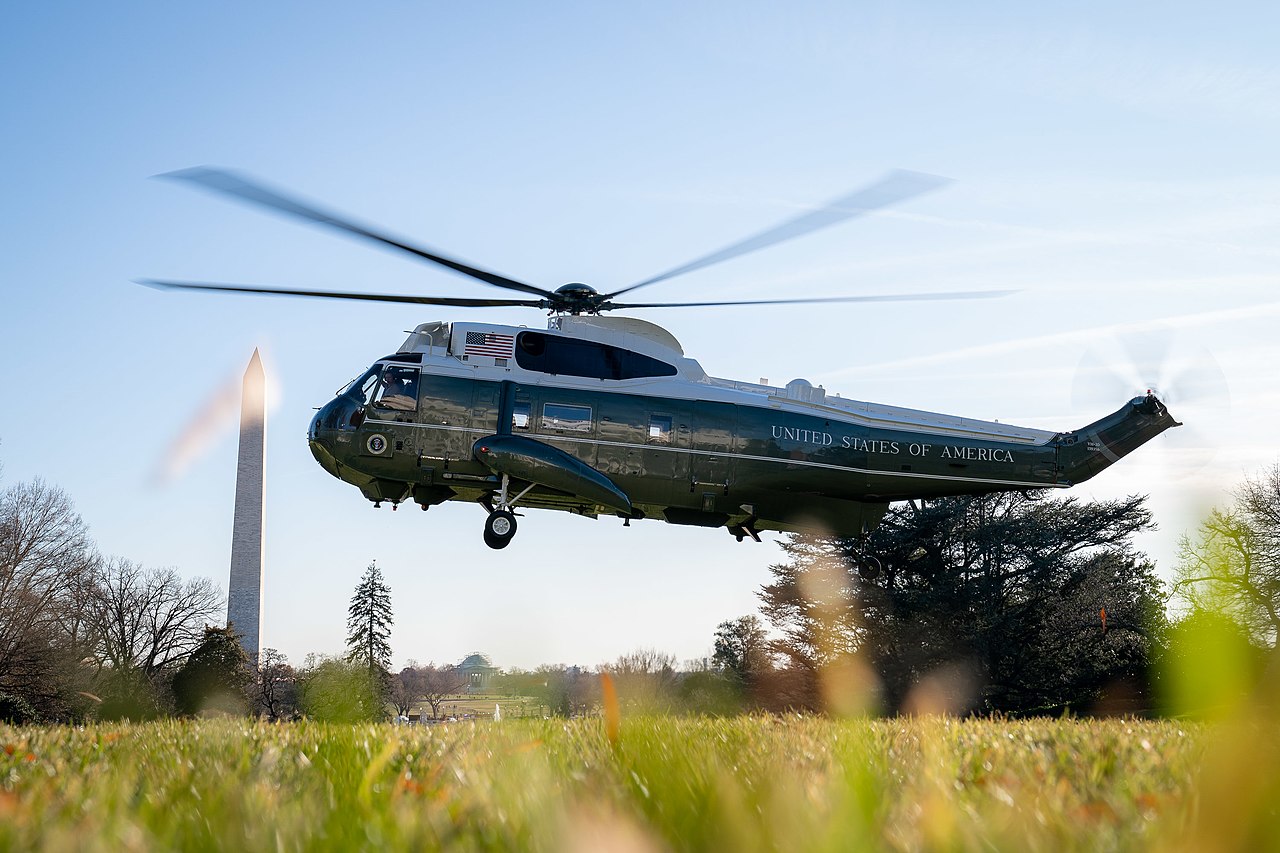


Overview and purpose
Marine One is primarily used for short- to medium-range trips where speed, flexibility, and security outweigh the range of fixed-wing aircraft. Common missions include transport between the White House and Andrews Air Force Base, trips to Camp David or other official residences, and short hops across congested urban areas where ground travel would be slow or insecure. The helicopters are configured to provide secure communications, comfort for the President, and systems that respond to security threats.
Aircraft types and equipment
The Marine One role has been filled by several helicopter models over time. These aircraft are operated and maintained by Marine Helicopter Squadron One (HMX‑1). Typical features of Marine One helicopters include enhanced radio and satellite communications, redundant flight systems, environmental controls, and defensive measures intended to reduce vulnerability to threats. Interiors are customized for presidential use, with seating, work surfaces, and secure communications capable of supporting the duties of the office in flight.
Operations, unit, and procedures
HMX‑1, the Marine Corps squadron responsible for presidential airlift, plans and executes Marine One missions. When the President travels by helicopter, multiple airframes commonly fly together: one carries the President, while others serve as decoys or support aircraft. Ground and aviation security elements coordinate landing zone preparations, advance teams, and motorcade connections to ensure continuity and safety. Because the call sign is tied to the person aboard, an aircraft carrying both the President and the Vice President would be identified as Marine One for the duration of that flight.
History and development
The concept of a presidential helicopter developed in the mid‑20th century as helicopters became reliable enough for executive transport. Over decades the program has evolved to incorporate advances in avionics, communications, and defensive systems. Procurement and modernization efforts periodically replace or upgrade airframes to meet contemporary operational and security needs.
Notable facts and distinctions
- The call sign is a procedural identifier, not a proper name for a particular helicopter.
- When the Vice President travels alone on a Marine aircraft it is called Marine Two.
- Multiple helicopters often fly together during presidential movements to complicate targeting and to provide backup.
- Details about specific defensive systems and some operational procedures are restricted for security reasons.
Marine One remains a visible symbol of the presidency and an example of how aviation, security planning, and communications technology combine to support modern executive travel. For more formal or technical references about aircraft types and squadron responsibilities, see resources on Marine aviation and HMX‑1 operations such as Marine aircraft documentation.
Related articles
Author
AlegsaOnline.com Marine One — U.S. presidential helicopter call sign and operations Leandro Alegsa
URL: https://en.alegsaonline.com/art/61940