
Manila
Manila is the historic capital city of the Philippines, a dense urban center on Luzon at the head of Manila Bay and the core of the larger Metro Manila region.
Overview
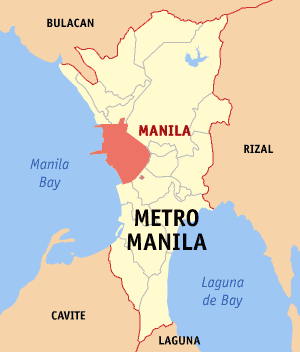
Manila is the national capital of the Philippines and one of the country's oldest and most densely populated cities. It sits on the eastern shore of Manila Bay on the island of Luzon and serves as the political, economic, and cultural core of the nation's capital region. The city proper has a population of roughly one and three-quarter million people, while the surrounding metropolitan area, commonly called Metro Manila, is far larger and combines many adjacent cities and municipalities into a continuous urban zone.
Image gallery
6 Images



Geography and layout
Manila's position on Manila Bay has made it an important port and gateway for centuries. The Pasig River runs through the city and connects the bay to Laguna de Bay, a large lake to the east; historically the urban area grew along these waterways. The broader metropolitan area stretches across a narrow isthmus that separates the bay and Laguna de Bay and includes a variety of coastal and inland districts. The island of Luzon, on which Manila sits, is the largest island in the Philippines.
History and development
Manila's history extends from precolonial trading settlements through Spanish colonization, American administration, and modern independence. The walled district of Intramuros preserves the city's Spanish-era core and several historic churches and fortifications. Over centuries Manila developed as a commercial hub, an administrative center, and a diverse cultural meeting point where indigenous, Asian, Spanish and later American influences intersected. The city suffered extensive damage during World War II and was rebuilt in subsequent decades.
Districts, landmarks, and culture
Manila contains distinct neighborhoods and landmarks that reflect its layered past. Notable areas include the historic walls of Intramuros, the financial and civic zones near Ermita and Malate, and Binondo, known as one of the oldest Chinatowns in the world. Public spaces such as Rizal Park and several colonial-era churches, including San Agustin Church, attract visitors and residents alike. The city's cultural life includes museums, theaters, festivals, and a lively street and culinary scene tied to its varied communities.
Role and distinctions
As the seat of national government, Manila hosts many government offices, foreign embassies, and cultural institutions. It differs from the larger Metro Manila area in administrative scope: Manila is one of several cities within the metro region. The city's local language and heritage are linked to Tagalog culture; the native name appears in Tagalog and traditional scripts, and local speech forms a foundation of the national language (Tagalog). Manila is the recognized capital (capital) of the Philippines, and its urban geography includes features often described by planners as an isthmus connecting coastal and inland zones.
- Major functions: government, port, commerce, culture.
- Historic features: Intramuros, colonial churches, war-era sites.
- Modern challenges: congestion, flood risk, and rapid urban growth.
Related articles
Author
AlegsaOnline.com Manila Leandro Alegsa
URL: https://en.alegsaonline.com/art/61337