
Magellanic penguin (Spheniscus magellanicus)
A medium-sized banded penguin of southern South America. Covers appearance, range, breeding, diet, behavior and conservation, with links to major parts of its distribution.
Overview
The Magellanic penguin (Spheniscus magellanicus) is a temperate, banded penguin native to the coasts of southern South America. It is the most numerous species of the genus Spheniscus and is commonly seen on beaches and rocky shores where it nests in burrows, under vegetation or in shallow scrapes. Populations are estimated in the low millions, often cited around 3.6 million individuals, though local numbers vary with environmental conditions and human impacts.
Image gallery
10 Images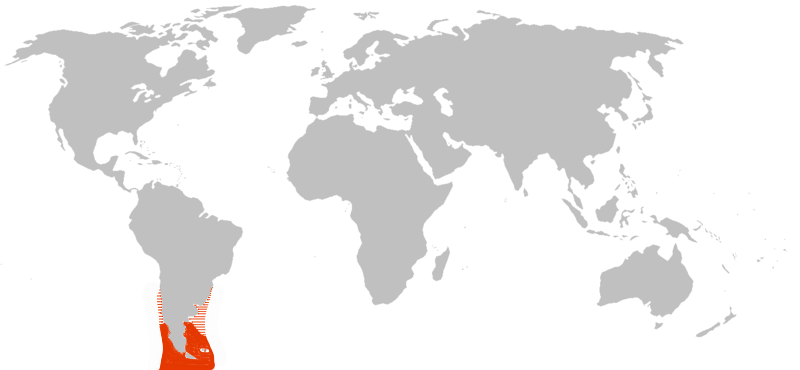


Physical characteristics
Magellanic penguins are medium-sized seabirds, typically measuring around 70 cm in length and weighing roughly 3–5 kg. Their plumage is black on the back and white below with two black bands across the chest that give the species its distinctive, banded appearance. They show a white facial border and dark bill. Like other penguins in the genus, they are streamlined for swimming, with flipper-like wings and dense insulating feathers. Adults undergo an annual moult during which they replace all feathers and remain ashore until the process completes.
Range and migration
These penguins breed primarily along the coasts of southern Argentina and Chile and on islands off the coast of the southern Atlantic. Major breeding sites include the Falkland Islands and coastal areas of Argentina and Chile. Outside the breeding season many birds disperse northward along the Atlantic coast of South America, and some reach coastal Brazil in winter. Movements are driven by food availability and breeding cycles rather than long-distance, rigid migrations seen in some other seabirds.
Breeding and lifecycle
Magellanic penguins typically breed once each year, timed to the Southern Hemisphere spring and summer. Pairs usually lay two eggs of similar size; both parents share incubation duties and later care for the chicks. Chicks grow quickly and commonly leave the nest (fledge) at about 60–70 days old, after which they begin to forage independently. Young may form loose groups, called crèches, for protection while parents are at sea.
Diet and behavior
The diet consists mainly of small schooling fish, squid and crustaceans. Foraging is generally undertaken at sea; individuals may forage alone or in groups and can dive to catch prey underwater. On land they are social and vocal, often gathering in colonies for nesting and resting. Predators of adults and juveniles include large marine mammals and seabirds; eggs and young are vulnerable to skuas and introduced terrestrial predators at some colonies.
Threats, conservation and human interactions
Magellanic penguins face a range of human-related threats. Oil pollution, entanglement in fishing gear, disturbance of nesting areas, and changes in prey distribution due to overfishing or climate variability all affect local populations. Many conservation efforts focus on pollution response, protection of breeding colonies and monitoring population trends. Because the species nests on accessible beaches, it is often visible to ecotourists and researchers, making it an important indicator of coastal ecosystem health.
Notable facts and history
- The species belongs to the genus Spheniscus, which includes several banded penguins of temperate waters.
- European sailors first recorded these penguins during early voyages along the South American coast in the 16th century, and their common name honors the region explored by Ferdinand Magellan’s expedition.
- Observable behaviors—such as annual moulting, shared incubation, and coastal foraging—make the Magellanic penguin a frequent subject of seabird studies and a familiar species for visitors to southern beaches.
For more region-specific information and conservation guidance see resources linked for the Falklands, Argentina, Chile, broader South America and Brazil: Falkland Islands, Argentina, Chile, South America overview, Brazil (winter range).
Author
AlegsaOnline.com Magellanic penguin (Spheniscus magellanicus) Leandro Alegsa
URL: https://en.alegsaonline.com/art/60576